



French Guiana set to tackle bycatch
A new law requiring French Guianese shrimp fishers to use special devices that reduce unwanted fish catch will help better protect marine turtles and other vulnerable marine species in the region.
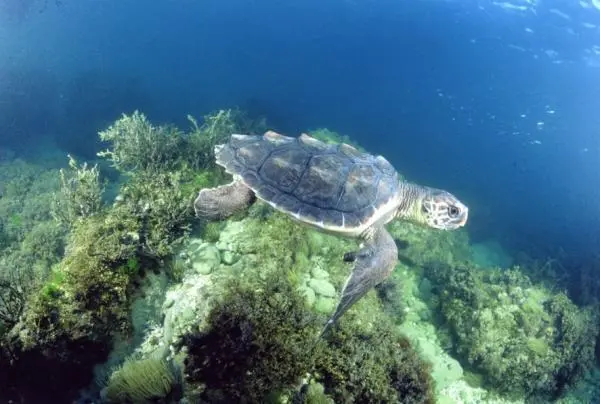
As of 1 January, the country’s fishing fleet under the new law now has to use a device called the Trash and Turtle Excluder Device, or TTED, to limit accidental capture of larger marine species.
Widespread use of this device, which took three years to develop, will greatly reduce bycatch among shrimp trawlers. In French Guiana, tropical shrimp fisheries represent a major source of undesired bycatch. Without a bycatch reduction device in place, shrimp represents only 10 to 30 per cent of the total catch, meaning the rest is made up of other marine species.
The TTED is an improvement of a previous device, the Turtle Excluder Device, that consists of a rigid grill inserted at a 45 degrees angle in the trawl with an opening toward the top or bottom. NOAA has documented in research a 97 per cent reduction in marine turtle captures through using the device, and additional TED studies conducted internationally have shown a reduction in large marine organism bycatch of as much as 91 per cent.
After three years of trials, a prototype combining the advantages of different systems was identified. This model, the TTED, offers numerous advantages, including a 25 to 40 per cent reduction of fish bycatch.
The TTED is the culmination of years of research. With funding provided by the European Union and the DIREN (Regional Environmental Authorities), WWF commissioned a study from IFREMER (French Research Institute for Exploitation of the Sea) to determine which selective gear was the most adapted to fishing conditions in French Guiana. These initial trials, conducted under experimental conditions, were carried out on board a shrimp trawler.
Following this work, shrimp industry’s members expressed the need to continue these experiments and to become more involved in the project. In response, WWF and the French Guiana Regional Fishery and Ocean Farming Commission began working in close collaboration in order to determine the best gear for the French Guiana fleet.
With technical support from NOAA and IFREMER, the Commission carried out numerous at sea trials in close collaboration with French Guiana fleets. Specific parameters where tested such as the shape and spacing between the bars of the selective grid. These trials allowed the fleets and the crews onboard the shrimp trawlers to understand the advantages of a more selective fishing gear and the benefits of using it in French Guiana.
Based on the results and the captains’ recommendations, the Commission decided to make the use of this TTED system mandatory by January 2010, when the annual fishing licences are issued.
Related Articles
 FISHERIES
 FISHERIES
 WORLD FISHING EVENTS