



Flog the trawlermen?
Trawling may boost stocks
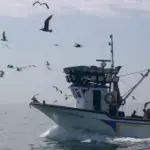
Every so often one pressure group or a non-governmental organisation (NGO) blames the trawling fishing industry for “bulldozering” the sea bottom and “devastating” the homes of the creatures whose habitat it is. Some of these alarmist outbursts may stem either from ignorance about how and where trawling is done or be motivated by outright spite. Their publication can mislead the public at large and cause frustration among those who work the trawler industry.
These recount stories of trawling which has destroyed the seabed and killed off bottom species, and can only lead to a calamity in our seas and oceans. Yet, these campaigns are not about overfishing — they are campaigns to stop fishing.
Back in April 1998, I wrote: “The simple truth is that trawling grounds cover considerable parts of our planet’s continental shelf.” Year in and year out, year trawlnets pass over any point of these perhaps a few perhaps a dozen times. And for many decades these same trawl fisheries continue to yield more than a quarter of the world’s 80-90 million tonnes of fished which fishermen land in port for people to eat. And their value is far more than their volume by weight of the global catch. So, how in the world, if these habitats are truly being continually “destroyed”, “devastated”, “crushed”, and “scoured”, can they possibly produce such yields year after year, decade after decade, and generation after generation?
There are other contradictions which have to be tackled too.
Back in 1998 my comment was that : “frequently-fished sea bottom ceases being ‘virgin’. It becomes a demersal fishery ecosystem with fishing as an inseparable component. So, it undergoes a permanent (though by no means irreversible) ecological change due to both the effect of fishing gear on the bottom and the intensive harvesting of demersal biota. Trawling grounds represent, therefore, ecologically modified habitat… hence fishing excludes the option of conserving sea-bottom habitats in their virgin form”.
Fortunately there are some in the marine biology community who are far more cautious in putting forward views about damage from trawling. In 2002, the U.S. National Research Council (NRC) published “Effects of Trawling & Dredging on Seafloor Habitat” (www.nap.edu). NRC is part of the U.S. National Academies, which group the most learned scientific authorities in the US.
The report was written by the NRC Ocean Study Board’s Committee on Ecosystem Effects of Fishing.
If such a learned committee says much more information is needed to draw scientifically-sound conclusions about the issue, how could the anti-trawling buffs know what they’re talking about?
Know your habitat
The point is, that there is a lack of data on the distribution of habitat types and on the effort exerted. It is lacking also on the effect of trawling on the overall productivity of the various bottom dwellers and on how often and to what geographic extent trawling and dredging occur in different types of marine habitats.
The Committee is of the opinion that while trawling could be destructive in ecologically vulnerable habitats, some sandy habitats, especially in areas that are subjected to naturally high levels of disturbance, are resilient to the effects of trawling. Thus, the main recommendations are further research and data collection, a habitat classification system and standardised criteria for management of “essential fish habitats” and “habitat areas of particular concern”. It also wants to see new management plans supported by the results of monitoring and evaluation of the consequences of existing measures to manage the stock.
In addition these measures should be tailored to meet the needs and particularities of specific habitats and fisheries. That would in part be achieved through a balanced combination of effort reduction, gear modification and restrictions, as well as possibly closing off habitats that suffer damage from even minimal fishing. So, there is a whale of difference between the NRC report and the anti-trawling campaigners’ slogans.
However, having praised the NRC report, what I found lacking in it was recognition of the fact that the effect of trawling might well be considered in the context of what farming and ploughing does to farmland. Clearly, farming the land means man is permanently changing it from its primaeval state across the continents. Just as bad farming, which overexploits the soil, can bring about desertification, so overfishing can lead to stock depletion. Trawling with heavy gear on coral reefs can be compared to farmers destroying unique forest habitats to clear sites for commercial crops.
Hence, no one should be any doubt that we must consider the possibility that there will be areas which should be declared marine nature reserves or “marine protected areas” (MPA). In many marine areas the character of the seabed precludes any kind of trawling. Non-trawlable bottom may extend over substantial sections of the continental shelf and represent a natural choice to accommodate MPAs. Trawler skippers are usually aware of the biogenic value of such grounds. They benefit from their largess and productivity by fishing in the neighbourhood, but avoid trawling on them directly.
Ask the Faroese
Olaf Olsen used to be the Faeroese minister of fisheries and more recently the managing director of the Faeroese Beta company. He gave me access to 25-years worth of detailed data from the Beta’s fleet trawling operations. The company’s eight pair trawlers (and another 22 vessels besides Beta’s ) have traditionally chosen to trawl a specific area of about 3,000 sq. km. I estimate that for the last 25 years, therefore, every point on that 3,000 sq. km. fishing ground was trawled on average at least eight to nine times a year covering many thousands of kilometre trawls. If they had been ‘bulldozing’ the seabed, and by implication destroying it, then how was it that in 2003 they had record catches-per-day and some of the best total catch from that area in 25 years? So, while everyone would agree that one must ensure that care is taken to protect reefs and other particular biogenic habitats, at the same time one must recognise that if you are going to have a productive fishery in an area, then inevitably you are going to have a modified bottom ecosystem. The data from the Faroes vessels shows that a trawl-fishery, which produces sustained yields over many years, is not destroying but rather rationally exploiting the fishing grounds and their resources.
Since some of those who actively campaign against trawling, saying it is devastating habitats, may be ignorant of the realities of fishing, they may be excused. But marine biologists who keep propagating this seabed devastation nonsense should know better and they owe us all an explanation.
Related Articles
 FISHING TECHNOLOGY
 NEW VESSELS
 FISHING TECHNOLOGY