


Scottish aquaculture open for business
Scottish government sees a bright future for aquaculture, but it also recognises that it’s not all plain sailing for the industry, new Minister for Employment & Investment Tom Arthur told attendees at the Aquaculture UK 2024 exhibition.
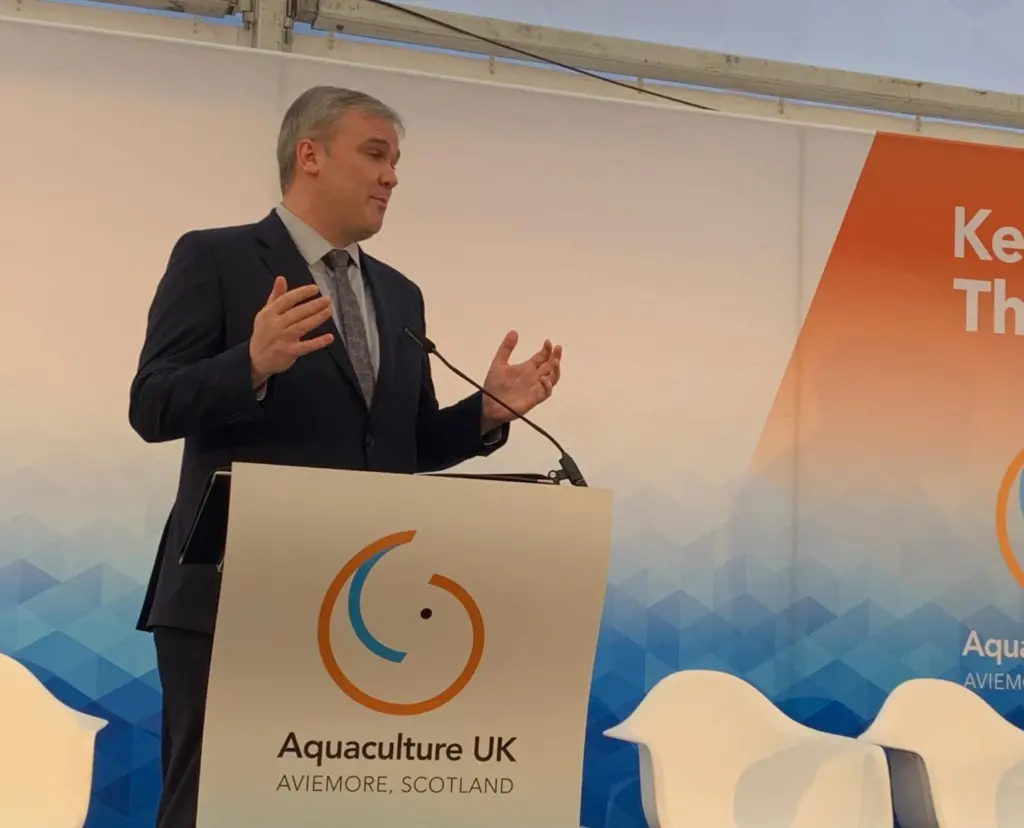
Delivering the keynote address at the two-day event in Aviemore, Scotland, held on 14 and 15 May 2024, Arthur insisted that the country’s aquaculture can deliver on the government’s four overriding priorities of eradicating poverty, driving economic growth, meeting climate obligations and investing in public services. He also acknowledged that it’s already a “significant contributor” to rural and highland economies, providing well-paid jobs in some of the country’s most fragile communities.
He highlighted aquaculture generates more than GBP 885 million for the Scottish economy every year, and that farmed salmon represents one of the UK’s main food exports, with an estimated value of GBP 578 million in 2022.
That, added to trout, oysters and mussels, as well as a “burgeoning seaweed sector” makes Scottish aquaculture an important provider of “healthy, nutritious meals”, which is aligned with the government’s aim to ensure Scotland is a “good food nation”, Arthur said.
“Scotland is well-placed to deliver further economic growth. But to do so, it must be sustainable,” the MSP said. He also noted that fish farming and shellfish farming have a lower carbon profile than many other forms of animal protein production, and that there’s increasing investments being made in new technology to meet net-zero ambitions.
“However, achieving this bright future is not without its challenges. To have a thriving sector, everyone knows we must take care of our fish. This will in turn allow us to take care of our people. Scottish government recognises the importance of fish health and welfare to productivity and reputation as a nation producing sustainable food.
“Managing the survival of fish has been a challenge, with [the sector facing] a number of events in recent years. We know that fish farmers and fish health professionals work extremely hard to care for their livestock and that the sector is improving husbandry [in terms of] health, welfare and productivity. We are committed to working collaboratively with producers, fish vets and regulators to improve fish health.”
Arthur, who was appointed to the ministerial position this month, highlighted the support being given to the industry, including the new GBP 1.5 million funding received by the Sustainable Aquaculture Innovation Centre (SAIC) to progress research and development (R&D) in the field of fish health and welfare.
As previously reported by WF, the funding package includes GBP 500,000 from the Scottish Government’s Marine Fund Scotland and GBP 1 million of transitional funding from the Scottish Funding Council (SFC).
“Scotland is open for business, and as Minister for Employment & Investment, I want to deliver increased employment and investment in Scotland,” he said. “I’m impressed by the enormous success of this sector and the drivers of its expertise and knowledge. Investing in aquaculture’s future is crucial and it’s important we continue to work together to ensure its long-term sustainability.”
Related Articles
 SEAFOOD
 AQUACULTURE
 SEAFOOD