

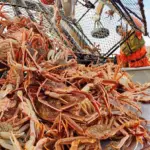



A shipload of cod
It is now clearer than ever before that bad scientific data has unnecessarily poisoned and devastated the lives of tens of thousands of fishing families across Europe, and sent the careers of many young and older professional fishermen into terminal decline.

World Fishing (WF), writes Peter O’Neill, has always cast a sharp, doubting eye over the validity of “scientific” data used by national officials and politicians to manage Europe’s stocks. Bad data, by definition, is almost certain to produce wrong decisions.
WF has carefully noted common-sense solutions, operated locally and regionally and pursuing “natural” seasonal marketing, to avoid the gigantic waste of discarded fish. That waste is the product of a control regime’s clearly unworkable policies and policing, with the latter criminalising the fishing community. Ironically, Joe Borg, in February condemned 880,000 tonnes of EU discards (certainly a ‘guesstimated’ figure). Yet it was wrong data and bad decisions via the Commission that helped cause the waste.
Last month, the North Sea Regional Advisory Council (NSRAC) successfully organised an international two-day, cross-stakeholder meeting in Edinburgh on the future (or lack of it) for cod. The conflicting evidence which emerged [WF will examine in detail its implications, across all stocks, later] reinforced the indictment of the shocking omnipresence of flawed data leading ministers to discard so many fishing lives.
Rapporteur Professor Tony Hawkins summed it up saying: “People looking at essentially the same information are coming to radically different opinions about the state of cod stocks. Some are concluding emphatically that cod show no signs of recovery, and that the cod recovery plan has not worked. Others are concluding that in some areas at least cod are recovering, with good recruitment during 2005…It is a feature of the advisory process that we have very little information on the current state of the cod stock”.
As one Scandinavian said, no businessman would touch a company whose books showed such poor backroom data.
WF welcomed Dr Franz Fischler’s RACs, despite their lack of teeth. Maybe fishermen’s own data might at last stand equal on the policy table. However, Dick James, representing most Northern Ireland skippers, told WF the symposium just confirmed that his colleagues were not being listened too and were still being talked down at. That is why they and Dick are pressing ahead with their own data framework.
Commission officials honestly faced the facts, that cod strategies had not worked well enough and a fresh approach was needed. At last it is seen that “one size will not fit all”.
For many communities this is all too late. Further, WF was disturbed to find many fishermen and their families were not prepared (and even frightened) to speak up at the meeting. WF defends their right to be heard and for the fishing press to “tell it how it is”. Some told WF they had offered data in the past only to find it twisted against them. Skippers of small vessels should not have to fear that, if they speak out, they may be targeted or slyly victimised and so pushed over the edge into bankruptcy or suicidal despair. The depth of this cloaked anger is very worrying.
Some readers will know that ‘codology’ is slang for the study of a load of nonsense, ‘codswallop’. The meeting showed the fishermen have been right, not just about cod but other species. Today there is a shipload of cod in the sea, right down through La Manche (The Channel). Which shows how much of the “scientific” data has also been a ‘load of cod’. Fishermen should have fought back harder and earlier with their own real-time, hard data.
Willem de Boer, Dutch elder statesman of the sea, representing some 140 skippers told WF: “Today, …the world of the practical fishermen and the world of the scientists…are two completely different worlds”. The scientists played with their models like toys, and did surveys in absolutely the wrong places and with the wrong gear, he said. “They destroy fishermen’s communities, they destroy relations between fishermen.” Cod was not only doing reasonably well in some areas. There were “extreme increases” in other, just as sellable, products such as such as dabs and red mullet, never mind good results from nephrops, haddock, sole, plaice and monkfish.
Icelandic fishery consultant Jón Kristjiánsson told WF no sensible person would put their money in a “recovery” strategy which had failed half a dozen times – yet scientists had persuaded officials to do precisely that on fish. It was time for a back-to-nature alternative, like the admired Faroese approach of “working and culling” the stocks, as in animal husbandry, to keep them healthy and buoyant. They have taken on board the little-researched, natural, 50- to 60-year life cycles of many marine species and believe cycle complexity is at the heart of stocks’ waxing and waning not blunt concepts of overfishing.
Poor, fish-rich countries, signing deals with the EU, should now be suspicious of EU “conservation management” clauses. Beware EU scientists bearing gifts of black holes full of dubious data, and saying: ‘You do not understand [you simple fisherman]’. You may be the next to be discarded.
Related Articles
 FISHERIES
 FISHERIES
 WORLD FISHING EVENTS