



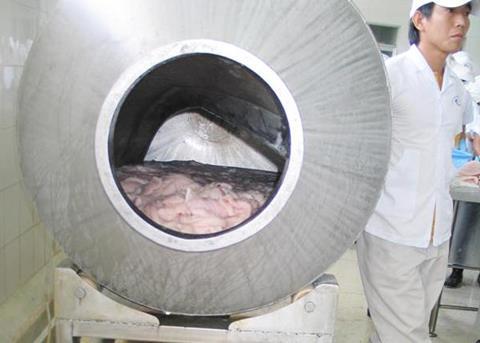
As well as the tumbling, or soaking, of seafood in a solution of sodium tripolyphosphate (STPP), there is also the practice of adding extra water in the form of glaze. In fact, both practices are usually carried out on the same product before and after freezing.
The objective, of course, is to sell cheap water as expensive seafood. And, unfortunately, this practice, which has been carried out in different countries for more than 30 years, is continuing, particularly with Vietnamese pangasius. Although the fish is relatively inexpensive, competition amongst producers is so severe that any opportunity to lower the selling price is seized upon.
The use of STPP in food products is not illegal – it is commonly denoted as E number E451 – but many countries regulate the amount allowed in seafood because it can substantially increase the sale weight of products (in the EU and USA, the legally permitted level of STPP in seafood products is 0.5%).
Last year the Federal Institute of Fisheries in Hamburg, Germany, carried out tests on imported Vietnamese pangasius fillets and found that some of them had water contents as high as 90% when there should have been a maximum level of 85% even if, as is usual, the fillets had been glazed.
These findings caused complaints, and importers in Russia and Poland were also very unhappy when they received glazed and fully soaked pangasius fillets from Vietnam.
Meanwhile, tests carried out on pangasius in Vietnam itself found water contents ranging from 78.21-80.96% for whole fish and from 78.84-82.07% for untreated fillets. Then, depending for how long the fillets had been tumbled in STPP solution, the water content ranged from 82.6-87.17%, or a weight gain fluctuating between 5% and 20%.
Apparently a weight gain of 50% due to the use of STTP has been found in Vietnamese pangasius fillets, so the potential for fraud is enormous.
Again, the amount of glaze can vary between the accepted 5-10% – as long as it is declared, or the net weight of the product stated on the pack – up to 30% (20% glaze is the official maximum allowed in Vietnam).
While the amount of glaze can be determined by simply allowing the product to thaw, and the use of STTP can easily be detected; there has been a sinister development in the use of a non-phosphate additive which is virtually untraceable. Called MTR, it consists of a mixture of sodium bicarbonate, sodium chloride (table salt) and citric acid. Fillets dipped in MTR are said to be regarded as untreated as it is so difficult to detect the compound.
So, one form of adding weight, which hopefully is about to be stopped, could soon be replaced by another. However, it is to be hoped that the Vietnamese government can ensure that processors there abide by the new regulation for the good of the seafood industry.