



Philippines
The Philippines looks to aquaculture for long-term growth. David Hayes reports. – Not only has farmed fish in the Philippines overtaken wild catch, as in China, Filipinos are generating valuable income from value-added in areas such as seaweed exports.
The Philippine government’s Bureau of Fisheries and Aquatic Resources, part of the Department of Agriculture is drawing up a long term plan for the development of the fisheries industry to run between 2005 to 2010. The new plan is expected to increase the Philippines’ reliance on aquaculture to boost fisheries production while encouraging better conservation practices and so ensure sustainable long-term development of the inshore and commercial fisheries sectors.
According to government figures fishery production in the Philippines reached a record total of 3.62 million tonnes (Mt) in 2003, registering an increase of 7.4 per cent compared with 3.37Mt 2002. Figures include about 900,000t of seaweed, which is an important export item. Fishery production has grown over the past decade mainly due to a 65 per cent increase in aquaculture production along with a 23 per cent rise in the commercial fisheries catch over the same period. Municipal or inshore fisheries production, however, witnessed a decline from the early 1990s before gradually beginning to recover in the late 1990s.
Aquaculture
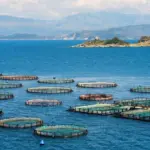
Aquaculture accounts for 40 per cent of total fisheries production and in 2003 it registered the largest increase, growing by 8.7 per cent to reach 1.45Mt. Output expanded by 120,000t annually from 2000 to 2003. Aquaculture has grown almost every year from 1993 when an output of 794,000t was recorded and eventually overtook commercial and municipal fisheries production in 1996.
“We are encouraging fish cage and tilapia culture, not just for local consumption but for export. We are trying our best to sell fish products abroad,” commented a Bureau of Fisheries official. “For Tilapia we are doing hybrid research to get them to market size in a shorter time. Tilapia are for food security, not for export. They were developed for the poor to eat. They need 45 to 60 days for growth.”
Mariculture, almost entirely seaweed along with small tonnages of oysters and mussels, accounts for about 65 per cent of total aquacultural production, while brackish water production represents a further 18 per cent of output. The balance is from freshwater farming.
Milkfish, known locally as bangus, is the major brackish water aquaculture species representing about 80 per cent of brackish water production, followed by prawns. Tilapia is the major freshwater farmed species, accounting for more than 90 per cent of freshwater fish farm production. Efforts to develop aquaculture production focus on five species: prawns, tilapia, milkfish, seaweed and mud crabs. The latter can be raised in brackish water and are exported to Taiwan and Hong Kong. In addition, sea bass, fish-cage culture is under development in various locations.
Commercial fisheries
Commercial fisheries, which account for 31 per cent of total production, grew by 6.5 per cent to reach 1.11Mt in 2003 from 1.04Mt the previous year. Production expanded by about 60,000t annually in both 2002 and 2003. It has grown almost every year since 1993 when the catch stood at 824,000 t.
Roundscad is the major species caught by the commercial fishing fleet in tonnage terms, accounting for about 22 per cent of the commercial fisheries’ catch. Indian sardine is the second largest item, accounting for about 14 per cent, while frigate tuna represent around 10 per cent of the commercial catch. Other important species include skipjack, yellowfin and big-eyed tuna which collectively represent about 14 per cent of the catch.
Municipal inshore fisheries production totalled 1.05Mt in 2003, up 17 per cent from 857,000t the previous year, and representing 29 per cent of the Philippines total fisheries output. Production grew by 6.7 per cent compared with the previous year to reach the highest level in a decade. The previous peak catch recorded was 1.01Mt in 1993, which then declined to a low of 891,000t in 1998 before beginning to recover once again.
Frigate tuna and big-eyed scad (goggler) are the two major species caught in inshore waters, each accounting for about seven per cent of the total municipal fisheries catch. Other important species, each accounting for four to five per cent of the inshore catch are roundscad, anchovies, Indian mackerel, yellowfin tuna, threadfin bream, squid, blue crab and Indian sardines.
The central Visayas region and Mindanao island in the south record some of the Philippines’ highest fisheries’ production figures. General Santos fishing port in Mindanao is the base for the country’s tuna fishing fleet which operates in territorial waters and in the Pacific, supplying tuna for the important tuna processing and canning industry centred on General Santos.
One million workers
Fisheries is an important employer and source of foreign exchange. According to the government’s 2002 Census of Fisheries, the fishing industry employs about one million people or five per cent of the Philippines‚ labour force. About 675,000 of those employed in fisheries work in the municipal sector while almost 57,000 people are employed by the commercial fisheries sector which includes tuna fishing along with the tuna, sardine and seafood-processing and canning industries. A further 258,000 people are employed in aquaculture.
Although the number of fishermen remains stable, the Philippines’ fishing population is ageing. As a result the government has established fishery training schools around the country to encourage young people to choose fishing as a career. “We offer scholarships for a four-year fishery course,” the Bureau of Fisheries and Aquatic Resources official said. “We give degree course scholarships to fishermen’s children; and free training to fishermen to become master fishermen. However, some Indonesian crew are used on distant waters vessels operating in Papua New Guinea, Fiji, the northeast Pacific and in Spain.”
Training is available to older fishermen as well, with extra efforts being made in areas where illegal fishing is a problem. The official explained: “There is still a problem of illegal fishing, using dynamite and fine mesh nets in spite of training being provided for locals about how to fish the right way and there being laws against illegal practices. Illegal fishing does not go on everywhere. It depends on the local government in each area which has to monitor the situation. The national government is amending the fishing laws to adapt to the local situation.”
Vessels big and small
The nation’s commercial fishing fleet consisting of vessels over three tonnes numbers about 3,600 vessels totalling 270,000 gross tonnage. Doubts exist about the accuracy of official statistics on fishing boat numbers. This has prompted the Fisheries Bureau to take action to gather more accurate information on the nation’s fishing fleet to incorporate them in the 2005-2010 fisheries development plan which is being drawn up at the moment.
“We have started a 12 month moratorium from July 2004 to July 2005 to identify and document fishing vessels,” the official said. “There are no new licenses being issued for one year. This was planned in 1998, but enacted in 2004. We want to identify how many fishing vessels are operating in the Philippine waters.”
The Philippines is an archipelago of 7,107 islands with a coastline of 17,460km in length. The total territorial water area covers 2.2 million square kilometres of which 266,000sqkm are coastal waters and 1.9 million sqkm are oceanic.
“There is a problem as a lot of municipal fishing grounds are close to each other as there are many islands,” the official said, noting that inshore fisheries is a subsistence occupation in many parts of the country. “Commercial vessels are excluded from municipal fishing grounds, so we encourage them to go into international waters which some are doing. Our distant waters vessels want high value fish like tuna. We have an agreement with Indonesia to fish for tuna. We are drawing up bilateral fishing agreements with Brunei, Malaysia and Indonesia for parts of the countries that are close to each other and covering all trade issues.”
Consumption and currency
Per capita fishery consumption in the Philippines is 36kg a year, according to government figures. In fact, the large rural population consumes more fishery products (because of farmed production) than the urban population which has to pay higher prices for fish. “Fish are expensive in cities because of transport costs and higher living costs. Fish are cheaper in rural areas,” the official said.
Salted, sun -dried fish are popular in rural areas. “Bangus are usually deboned,” the official said. “Processors are filleting bangus and slicing the fillets into different cuts, some of which are higher priced. These are used for different value added bangus products. Some processors are developing new products like fish sausages, fish loaf, fish nuggets and fish burgers. We are changing from meat to use fish in these products.”
Meanwhile, the fisheries industry remains an important growing source of foreign exchange. In 2003 fishery exports totalled US$524 million compared with $79 million for seafood imports, mainly frozen fish for processing and fish meal for livestock and poultry feed use.
Fishery exports recorded a trade surplus of $445 million in 2003, up 8.8 per cent compared with the previous year. Major export items are tuna, prawns, seaweed, octopus and crab products while major fishery imports are chilled and frozen fish, and fish meal.
Japan accounts for about 25 per cent of the Philippines total fishery exports, followed by the United States with 20 per cent, Europe about 10 per cent, while Hong Kong, South Korea and Taiwan each take about six per cent. Tuna is the largest export item in terms of tonnage and value. In 2003 the Philippines exported 85,000t of tuna products worth $156 million. Canned tuna is the largest category with 56,800t exported worth $111 million. Fresh, chilled and frozen tuna exports totalled 28,000t worth $44 million.
“We export whole tuna to Japan for sashimi. The rest are canned or cut into loins for the US and Europe,” the official said, “Tuna canning in the Philippines has a tariff problem with the US compared with Andean countries. Also, the tin can cost is quite high. Catering cans of tuna for restaurants and canteens are 1.88kg gross weight with 1.4kg tuna contents.”
The United States is the largest market for fresh, chilled and frozen tuna followed by Japan. Canned tuna exports are destined mainly for Europe, the USA and Canada.
Prawns and shrimp are the second largest fisheries export with 19,000t exported worth $125 million. More than 99 per cent of exports are fresh, chilled or frozen products. About 65 per cent are shipped to Japan. Other major markets are the United States and Spain.
Seaweed and seaweed products form another major export category with 42,600t worth $81 million shipped abroad in 2003. Europe is an important market for seaweed for food and nutricals.
Seaweed is exported dry, semi-dried, semi-refined and refined. Carrageenan, a seaweed extract used as a food additive, accounts for about half the seaweed export value and is used as a binder in hamburgers, ice cream, fruit juices and other products.
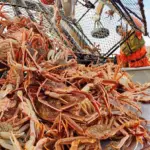
Other important fishery exports include octopus of which almost 12,000t worth about $32 million are shipped abroad annually. Crab and crabmeat are the other major export category with 5,200t exported annually and worth $32.7 million.