

A quarter of forced labour fishing vessels linked with Europe
One in four fishing vessels accused of forced labour are owned by European companies, with a quarter more flagged to China.
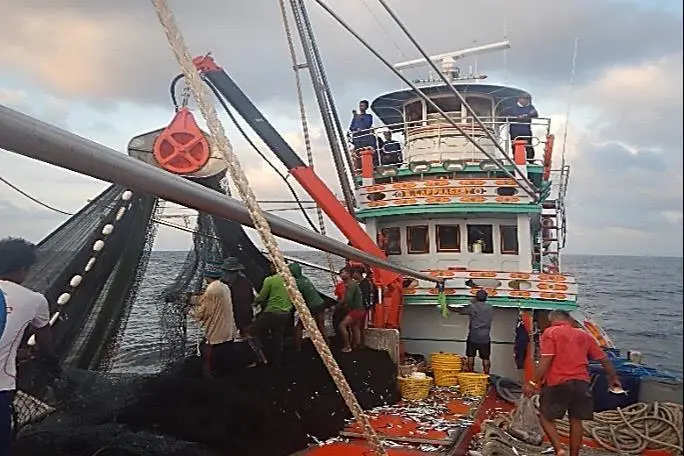
That’s according to a new report by the Financial Transparency Coalition which reveals that 22.5% of industrial and semi-industrial fishing vessels accused of forced labour were owned by European companies, topped by Spain, Russian and UK firms.
“Forced labour aboard commercial fishing vessels is a human rights crisis, affecting more than 100,000 fishers every year, leading to horrific abuses and even deaths among fishers who mainly come from global South regions like south-east Asia and Africa,” said Matti Kohonen, executive director of the Financial Transparency Coalition.
”Yet those owning these vessels mostly hide behind complex, cross-jurisdictional corporate structures ranging from shell companies to opaque joint ventures.”
Grim findings
The report entitled “Dark links: uncovering those behind forced labour on fishing fleets”, offers an extensive analysis of forced labour abuses in commercial fishing vessels. It also found that companies from just five countries – China, Taiwan, Thailand, South Korea and Spain – own almost two-thirds of accused vessels for which legal ownership data is available.
In total, 128,000 fishers, mostly from the global South, were trapped in forced labour aboard fishing vessels in 2021, often in the high seas, although the true figure could be much greater, according to the UN International Labour Organisation (ILO). They suffered abuses ranging from physical violence and debt bondage to abusive working conditions.
Other report key findings of the report include that more than 40% of industrial and semi-industrial fishing vessels accused of forced labour operated in Asia, followed by Africa (21%), Europe (14%) and LAC (11%).
A quarter of accused vessels were flagged to China, whilst 1/5 carried flags of convenience which have lax controls, financial secrecy and low or non-existent taxes.
Indonesia emerges as the global hotspot for forced labour cases, with nearly one-fourth of detected vessels operating in its waters. In addition, 45% of accused vessels operated or were detected in just five countries: Indonesia, Ireland, Uruguay, Somalia and Thailand.
It warns that beneficial ownership information is rarely, if ever requested, by most countries when registering vessels or requesting fishing licenses, meaning that those ultimately responsible for the abuses are not detected and punished.
The Financial Transparency Coalition is calling for five key measures to protect fishers and enhance transparency in the sector.
Firstly, it wants to improve publicly available vessel information. That is, before awarding a fishing license or authorisation, flag and coastal States should require information on the managers, operators and beneficial owners of the vessel. In addition, unified and publicly available lists of vessels accused of forced labour and IUU fishing should be created.
It also wants to create publicly accessible beneficial ownership registries. Unless there are publicly available beneficial ownership information, states will only end up sanctioning or fining the vessel’s captain, crew or the vessel itself, without being able to pursue the legal and beneficial owners who are profiting from these crimes.
Further, fisheries should be included as an extractive industry in key initiatives including the Extractives Industry Transparency Initiative (EITI) and other global and regional initiatives concerning regulation and transparency of extractive industries.
It also suggests that the EU Commission current proposal to ban products of forced labour from entering the European market also needs to be urgently approved and put into practice.
Related Articles
 SUSTAINABILITY
 FISHERIES
 FISHERIES