
Malta
Tiny Malta, sitting astride the Med, is once again at the heart of a battle for a sustainable future. The island epitomises the challenge touching the modern fishing industry: how to produce the tastiest and most lucrative of fish stews, made up of the sea’s offerings, tourists, cruiseliners, low-cost flights, high-tech bio-industries, Japan’s tuna markets and not forgetting the little-tapped partnership with neighbours to the south. Peter O’Neill reports.
Small is big. Iceland, 300,000 citizens, can claim to have dominated and won the cod war and today symbolises how small can shake stock exchanges with takeover bids, not just sell cod liver oil.
Malta’s 440,000 citizens, hosts to millions of tourists a year, are heirs to one of the greatest compliments a nation can win. In 1942 King George VI awarded the citizens of the “Island Fortress” the UK’s highest award for bravery by a civilian – the George Cross.
In 1943 Roosevelt visited them and said: “Under repeated fire from the skies Malta stood alone and unafraid in the centre of the sea, one tiny, bright flame in the darkness – a beacon of hope…”
The BBC archive reports that every day but one, over seven months Luftwaffe and Italian planes attacked the island. The aerial and sea siege lasted 16 months.
Battlefront
Malta became independent of Britain in 1964. It joined the EU 40 years later in 2004. A maritime nation, it lives on and by the sea – and the sun. Its strategic significance today is far more complex than in 1942. It sits right in the middle of the struggle to get the Med’s littoral states to agree on a long term plan for the Med. It could all go wrong and turn into a kind of third world war over the environment.
The combatants are legion and the Maltese like to moan. One example illustrates both confrontation and the need to share the sea. There is a well-defined tourist establishment of hoteliers, restaurateurs and travel agents. Sub-aqua diving in the local waters is a big earner for the tourist side. But tourist numbers dropped this summer: bad for fishermen, restaurateurs and divemasters. Poor relations worsened when divers accused the fisherman of allegedly trapping divers in their nets. One young Swedish divemaster, who starts his medical degree soon, told World Fishing relations were bad.
The irony is that divemasters, like the fishermen, may struggle to earn a living. Divers will not tell the fishermen if they have seen some interesting fish because they believe the boats will fish them out. Divers won’t alert fish farmers to holes they spot in their sea cages. Another problem is local thieves who, one cage guard said, breach the cages and cart expensive fish away in dinghies to sell to friends.
One reason World Fishing was in Malta was the International Offshore Mariculture Conference. Public concern over waste food and faecal matter collecting below inshore and offshore cages was discussed. That issue angers the scuba divers too. The meeting discussed the possible conversion of old oil rigs into command and supply centres for giant offshore fish farms. Obviously, the sub-aqua tourist divers and fishermen could share their expertise in areas such as maintenance on cages and oil rigs if they learnt to respect each others boundaries. But how to get them talking?
Malta is a major port of call for cruiseliners, disgorging tens of thousands of passengers every week to visit historic sights. Valetta is also a key bunkering transit point as fuel tax is low and fuelling vessels move around constantly and one recently got into trouble in bad weather. So, the tourist side fears pollution incidents. Recently a cage with nearly €2 million of uninsured fish was wiped out by an unknown vessel which disappeared into the night, and two expensive empty cages were also destroyed at a trial offshore farming trial site. The fish farmers accuse the government of unthinkingly putting that fishfarm project zone right in a main navigation lane. There have also been rows and legal moves over alleged dumping at sea (out of the giant container Freeport) of construction waste from landside tourism development. The latter is attacked as concretisation of the tiny island in pursuit of higher tourism numbers.
Tourism accounts for a massive 10 per cent of the economy and local seafood is part of that. Yet Maltese fish dishes are disappearing under the weight of starred hotels offering a preponderance of roast lamb, cauliflower cheese and sponge pudding (nonetheless excellent).
Meanwhile, the government has let the low-cost airlines come in, with Ryanair leading the charge. All these planes can carry belly cargo which can boost sales of speciality fish from around the Med. Tuna and the Japanese market also rank high. Cargo managers at Malta International Airport say that although tuna freight has dropped, it is still a good earner. Much is now being chilled on small ships from stock cage and then consolidated on a large reefer destined for Japan.
Pain to hope
But what of the southern Med and Africa beyond and the Middle East? Where are the tourists, why are there only a couple of flights per week from Malta to Tunis, Casa and Tripoli? From Pariah state, using Malta as a secret and not-so secret go-between, Libya is now doing business with everyone.
It is the economic migrants who are coming – needed, but sometimes unwanted. The EU’s FRONTEX naval patrol and police operate from Malta to prevent illegal immigration into the EU.
However, the Maltese are showing that pain can be turned into scientific hope. A decade ago, northern fishing nations dominated research in the catch and processing arena as well as pathology and hygiene consultancy.
Shane Hunter, Malta’s AquaBio Tech environment and research consultancy Technical Director, is young like most of his colleagues and academically they come from as far apart as Bangor and Bangladesh – biologist Towhid Alam studied in both. All stakeholders, they apparently have the old consultancy guard a little worried. Shane says the big players are now suggesting that small AquaBio Tech Group, with clients now in 35 countries, is the fifth most important fish consulting operation in Europe in terms of penetration.
Not only do they test and evaluate different kinds of fishfeed, offer pathology services, and environmental impact assessments, they are looking south, to the Gulf, Middle East, Maghreb countries and East Africa. They are advising on multi-million pound fisheries development projects in Saudi and Yemen and of course there is competition with scientific colleagues such as Professor and consultant Carmelo Agius.
After many hours chatting about fish entrails with these hands-on experts it is clear they also see the bigger picture in the Med’s and Africa’s young populations. Guardians of the daily health of fish stocks in the region and beyond, they also guard the independence of their advice to the fishing industry, whether in terms of toxic algae and seawater purity, residues, antibiotics, safe processing or the soundness of investment and potential markets.
Shane says that they win on quality as well as price, and Iain Pollard, Senior Consultant, aquaculture and fisheries economist responsible for marketing development, says they pass on Malta’s lower costs to their clients. Yet, they are also prepared to tell a client the real facts. The projected business might not have a sustainable future. If that means walking away from a well-paying contract, rather than compromise, then they would walk.
There is a sense of new frontiers being developed here and that the smart money is on the smart minds, whether fisherman or consultant. At the last minute, Prof. Agius takes World Fishing to the new, clean-industry area near the University. His childhood friend Charles Saliba, 44, a cell biologist (Bristol and Guy’s London) returned to Malta and was introduced by Carmelo to other scientists including Lyons-based pharmacologist Gilles Gutierrez. Four years of controlled, original research followed and today that has led to a successful multinational group which has grown out of the research outfit Saliba and Gutierrez helped set up – the Institute of Cellular Pharmacology (ICP).
They sell patented molecule derivatives from, among other things, the limestone loving, sea alga padina pavonica (Peacock’s tail). Malta is all limestone and the sea is ICP’s farm. Similar work on prickly pear and pomegranate has resulted in end products which help strengthen skin and bones and reduce stress – that means help against human osteoporosis, harder eggshells in poultry, reducing stress and firming up flesh in fish such as tuna and providing neutraceutical additives for the global cosmetic industry. Their extracts are in Lancôme’s Absolu range of skin care. Trials are also underway for shrimp shell-hardening. Charles says local prickly pear producers get twice the price now when they sell to him. Expansion has meant sourcing the fruit from Tunisia (where they have a factory). India and South Africa are in the pipeline as another seasonal source.
All this from one French pharmacologist and one Maltese cell biologist starting from nothing – the moral is to see your local patch with the eye of a scientist and remember your global patents.
Taxi service
Imperial English helps. But, just as important, Dr Francis Agius, Parliamentary Secretary (minister of state) for fisheries told World Fishing, is that Maltese is 80 per cent Arabic. Geopolitically, he says, Malta sits at the heart of the region. “We are small and have no big axe to grind and are not a threat in a world full of threats. The closeness to our African and North African neighbours comes from the language.”
The island has dozens of language schools teaching English to students from as far apart as Russia and Japan. Many Maltese also have Italian. So languages really can pay out there in the new world.
Agius admits they are trying to steal the Scandinavian emperors’ clothes when it comes to research and its promotion in the region. He says there needs to be more investment in the young population including North Africa. Because of the desert in the hinterland, that means the burgeoning population living along the coastal regions where wild and farmed fish can meet.
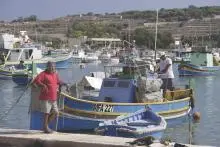
Ironically, Malta having shaken off the bulldog, now has the ability to be the centre of a new, more open empire of partnership. They have been trying to go “all the way” to create an intellectual and trading empire and offshore farming was an important way, he said, for regional fishermen to meet wild stock falls. Multitasking amongst Maltese fishermen meant there were probably 20 times more than the official number of fishermen running various business in the “informal” market. A fishermen would not only fish wild but also act as a ‘taxi’ for towing fishfarm cages for example, he said.
It only needed a small number of the right people to push the strategy forward. “Our entrepreneurial skills as Maltese and our lines of communication [across the Med] are much more open…” and he says they have no locally grown terrorism. The new type of fisherman might well run a bed and breakfast. He could be part of the push towards tourism and products linked to the Mediterranean diet and traditional Maltese fish cuisine, against the multinational hotel chain menus.
Francis Agius worries that, without increases in farmed, wild catch and present farmed may not meet demand. As for economic migrants from the south. He says many Bulgarians, for example, already work easily and legally in Malta’s maritime sector. The fact is that they can come here and go back home as they wish. So they are not seen as a threat seeking to hide. The future for this complex region may lie in people with minds open to partnership and crossing open borders based on the Med and young Africa. If fish stocks can move around as events change, why not people?