



Australia
Aquaculture is one of the Australias fastest growing sectors. While wild catch value fell last year, aquaculture production value increased. Pilar Santamaria reports. – Australias Economic Exclusive Zone (EEZ) is the largest in the world, covering 10,267 450 square km. However, its commercial catch ranks 52nd in the world, representing only 0.2 per cent of the worlds production.
Fisheries resources “Down Under” are not as productive and abundant as in other parts of the world due to the characteristic of the continent and the waters surrounding it. These characteristics include a narrow continental shelf, little runoff form the dry Australian continent, lack of permanent upwellings and a predominantly southwards flow of the main Australian coastal currents.
However, the commercial catch has a large component of highly-priced shellfish species such as abalone, scallop, penaeid prawns and rock lobster. In 2001, these species made up approximately 65 per cent of the total value of commercial wild fisheries production.
Up and down
In 2002/2003, Australian fisheries production increased by 4.9 per cent reaching 249,000 tonnes but value fell by 5.5 per cent to AUD$2.3 billion (1AUD$= US$0.77) as compared with 2001/2002, due to falling unit prices for many species, according to a report prepared for the Government. While wild catch value fell in both Commonwealth and State fisheries, aquaculture production value increased.
Australia’s most valuable fisheries, Western rock lobster fishery and Northern prawn fishery, rely on exports to maximise their price. Japan is the major buyer of prawns, abalone, tuna and rock lobster. USA buys 60 per cent of the rock lobster tails and is the main buyer of fish fillets. Taiwan and Hong Kong are also important buyers of rock lobster and abalone.
Australian fisheries are managed by the States/Territories, the Commonwealth Government, through the Australian Fisheries Management Authority (AFMA), or a fisheries Joint Authority. State/Territories manage wild fisheries worth almost 65 per cent of the value of fisheries production in the country and 23 per cent of aquaculture’s.
Conservation is increasingly important in decisions on the access to marine resources and habitats. Hence, one of the greatest challenges to Australia’s Government, industry, business and the community is ecological sustainable development of fisheries.
Landside
Aquaculture is one of Australia’s fastest growing primary industries. It represented 32 per cent of the value of the commercial fishing sector in 2003/2003 up from 17 per cent in 1992/1993. Since 1992/93 real value of aquaculture production has more than doubled from AUD$331million to AUD$743 million in 2003/2003.
In a global context, production is still modest, although it is increasing at about 13 per cent annually due to improved technology, interest from investors and the consolidation of markets for aquaculture products.
Since 2002, the Commonwealth Government and the industry have been developing a national programme, the Aquaculture Industry Action Agenda, to help the industry’s growth. Aquaculture’s production value is expected to reach AUD$25 billion by 2010.
The Government has already provided AUD$2.5 billion to implement the Aquaculture Action Agenda, based on 10 key initiatives: Making a National Aquaculture Policy Statement, implementing an industry-driven action agenda, expanding the industry within an ecologically sustainable framework, enhancing aquatic animal health and biosecurity, investing for growth.
It will also include: promoting aquaculture products in Australia and globally, tackling the research and innovation challenges, making the most of education, training and workplace opportunities, creating an industry for all Australians and promoting a regulatory and business environment that supports aquaculture.
The farmer’s menu
Five species contribute to the bulk of aquaculture gross value product. These are southern bluefin tuna, Atlantic salmon, pearls, prawns and edible oysters. In 2001/2002 these species made up 91 per cent of the aquaculture value.
According to a report prepared for the Fisheries Resources Research Fund, Southern bluefin tuna is the fastest growing aquaculture sector in Australia and this began in 1991 to add value to a severely diminished tuna catch quota. At present, 98 per cent of the Australian southern bluefin tuna is farmed. Juvenile fish of 15-25 kilograms are caught from December to March off the South Australian coast using purse seine techniques and fattened in cylindrical cages off Port Lincoln (South Australia) for 3-6 months.
In 2001/2002, Port Lincoln’s farms produced 9,245 tonnes of tuna valued at $260.5 million. Most of the production is sold exclusively to Japanese sashimi markets. Frozen product represents around 75 per cent of sales and half of the fresh chilled product is sold directly rather than auctioned.
The main risks for the industry in the short to medium term are the price outlook for high value fish in the Japanese market, the increasing production of farmed tuna in the Mediterranean and in North America and the acceptance of pelletised feed by locally- farmed, wild-caught juveniles.
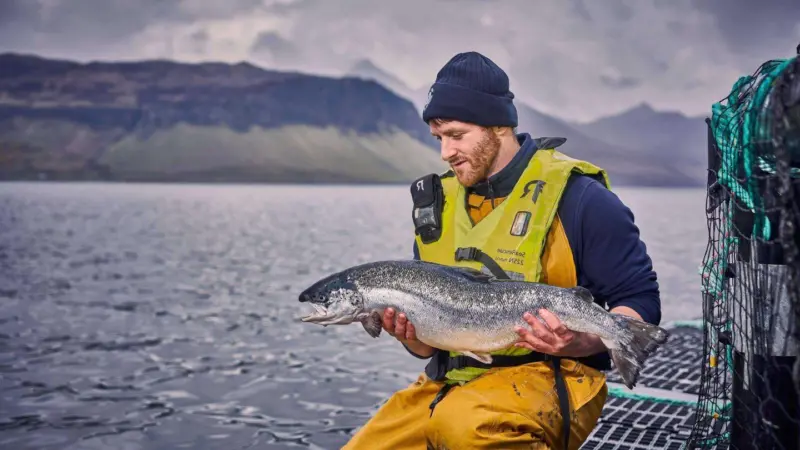
Atlantic salmon: most of the farms are in Tasmania. In 1999/2000, the value of farmed salmon was AUD$92.9 million. As Tasmanian salmonid production has risen, an increasing proportion of production is being sold on the domestic market. In the mid-1990s around the three-quarters of farmed salmon production was sold in the domestic market and a quarter exported to Asian markets. The Australian Bureau of Agriculture and Resources Economics (ABARE) has estimated that the actual share of the internal market has increased to around 85 per cent in 2000-2001.
In the last few years, production has risen, despite falling farm gate prices, and is facing competition from Pacific salmon imports from New Zealand.
In addition, the cost of production is still much higher than some of the larger aquaculture nations such as Norway, Chile, the UK and Canada.
Prawns: The main specie farmed in Australia, principally in Queensland and New South Wales, is the black tiger prawn. Banana, brown tiger and kuruma prawns are also cultivated. According to 2003 figures, almost all the farmed black tiger prawns produced in Queensland in 2001/2002 were sold on the Australian market. In New South Wales, all farmed black tiger prawns are sold in the domestic market.
Australia still imports around half of its domestic demand mainly from Thailand, India, Indonesia and Vietnam. The future of Australian marine prawns depends on world prawn prices and the competitiveness of the local industry to face the production from Asian countries.
Kuruma prawn is grown for live shipment to Japan. Traditionally, they were sold in fish markets in Tokyo and Osaka. Due to a decrease in sales and prices, producers are increasing their sales to customers direct and bypassing the fish markets.
This new strategy also includes Internet marketers and it is expected to increase sales and returns.
Edible oyster: Main species cultivated in Australia are the Sydney rock oyster and the Pacific oyster.
In 2001/2002, production of Sydney rock lobster, mainly cultivated in New South Wales was 7.6 million dozen, far from the 13-million peak reached in the mid-1970s. Since then, production has been decreasing. Production of Pacific oysters (grown in Tasmania, South Australia, and at Port Stephens, New South Wales) has risen to seven million dozen.
The main market for Australian Pacific oyster is the domestic market, however, exports are increasing and now account for 10 per cent of South Australian oyster sales.
Exports to Japan are also growing.