

Offshore Mariculture 2017, day four roundup
Highlights from the technical visits on day 4 of the conference, providing a unique opportunity for delegates to take a look for themselves at farming activities, just a few miles off Ensenada.
The first call was among the lines of buoys stretching away into the distance at an oyster farm, watching the strings of oyster cages being lifted and stacked on the deck to be taken ashore, with one of the cages making its way to the visitors’ boat for sampling. Stop number two under the cliffs at the southern side of the bay was at a mussel facility, where strings of rope-grown mussels were hauled and passed over a shaker to free them from the rope.
The sight of bluefin tuna at the offshore aquarium was something special. This facility provides the opportunity to see bluefin swimming and being fed, the sardines dropped into the water bringing them up to feed from the deeper part of the cage where they spend much of their time.
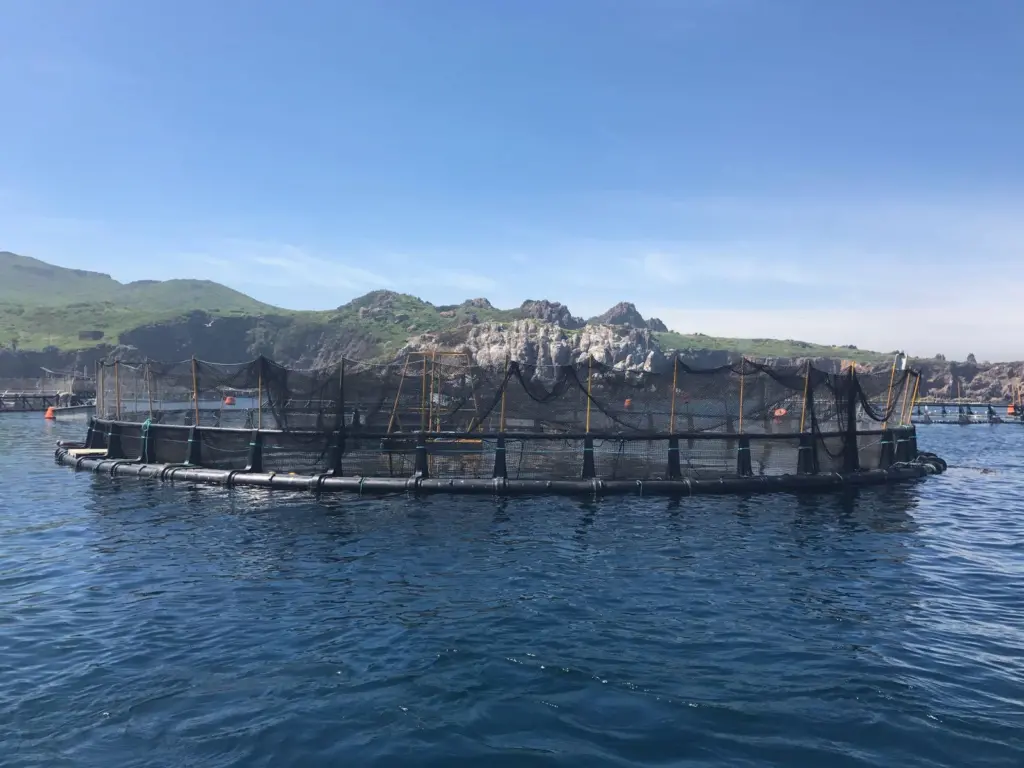
The high point was the call at Pacifico’s striped bass farm, located under the rocks of Isla de Todos Santos in an ideal location. Coming up to the farm, the sounder showed the undersea contours sloping steeply, with the Pacifico cages located at the edge of a canyon running to the landward side of the islands. It didn’t do any harm that the farm’s crew had harvested and prepared a couple of baskets of fish that were brought out to the visitors to give them a taste of striped bass.
The call at Pacifico’s farm, its cages lined up in the lee of the island and with the farm crew blowing feed to the fish, was the ideal way to finish the four day event with a practical demonstration of what can be achieved by taking mariculture offshore.
Also held on day 4 was the land tour, which was offered as an alternative to the sea trip. Participants were able to visit the Ocean Baja Labs Hatchery, Abulones Cultivados abalone farm and the Santo Tomas winery.
Ocean Baja Labs, part of Baja Seas, is a state of the art hatchery specialising in yellowtail production. Attendees were able to view all stages of the fish culture process, from the fingerlings right up to the brood stock. Fingerlings were produced in large quantities and kept at high densities of around 50 per litre which helped to keep them consistent in size and prevent cases of cannibalism.
The tour included discussions into feeding regimes, from the use of rotifers to pellets, and how the staff at OBL have tested feed efficiency in order to maximise production.
Abulones cultivados is an abalone farm perched high on the cliffs of the pacific coast. Sea water is pumped from the water below up to the farm so the abalone get a constant supply of fresh seawater.
Abulones Cultivados exports the majority of their products in canned form to the Asian market, but it also has a large following in Mexico. The company strive to keep their prices competitive, keeping the cost of a can below $25 where possible. Abalone is a delicacy and can take anywhere between 3 and 4 years to reach saleable size so growing conditions must be strictly monitored to avoid widespread mortality and a consequent decline in production.
This trip was preceded by a presentation on Abalone by Dr Yoon on day 3 of the conference, which helped to highlight its commercial value, production methods and the risks associated with land production of the mollusc.
The land tour culminated in a trip to the Santo Tomas winery, the oldest in Baja California, where we were able to sample locally produced wines and an authentic paella which conference attendees described as the perfect end to the week.
Did you miss the conference? Presentations and videos will be made available online from next week. If you are interested in downloading them contact the events team on +44 1329 825335.
Did you miss the conference? Presentations and videos will be made available online from next week.
If you are interested in downloading them contact the events team on +44 1329 825335.