

Russia: When the catch is no match
The 2009 fishing season was a successful one for the Russian fishing industry, reports Georgy Zaytsev.
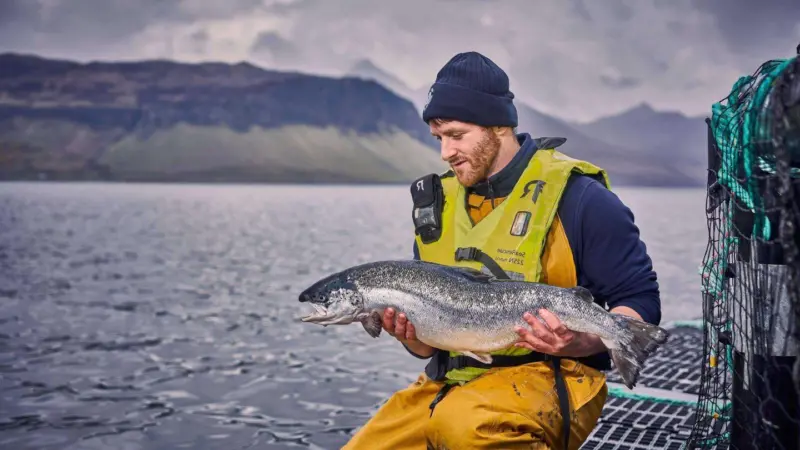
Fishermen in the Far East set an all-time record having caught 538,500 tons of Pacific salmon (mostly pink salmon, about 78 % of the total) – that was almost a threefold increase compared with the average yearly 200,000 tons for the last 100 years.
But the huge harvest of fish not only brought about fishermen’s jubilation but also caused great concern regarding the preservation of the catch and its delivery to consumers. In fact it was the case that the problem was not too few fish but too many.
Indeed, there were serious reasons to worry about the utilisation of the record catch. It must be born in mind that the Far East Region of Russia is a vast, mostly virgin, territory covered by high mountains and primeval forests (tayga) with a coastline stretching for several thousand kilometres.
Most of the fish landing sites are located in few civilized places (townships, settlements) and can be reached only by air or by sea (in summer). Due to harsh climatic conditions and for some other reasons (mainly financial) the existing inland transportation network is underdeveloped. The only reliable inland transport bridge between Vladivostok and Moscow is the so-called Trans-Siberian Railroad, which sprawls across more than 10,000 kilometres running through seven time zones.
The situation is aggravated by the lack of cold storage facilities and onshore fish processing plants. Those existing ones are often too small for the amount of fish that is coming into a port during a fishing season.
Theoretically, there were three main options to dispose of the rich catch:
Option 1: To consume all the fish locally
Option 2: To export most of the fish keeping only the amount sufficient for local consumption
Option 3: To transport the largest share of the catch to the Western part of Russia
Let us consider all the above options one by one:
Option 1
The whole fishing industry of Russia’s Far East accounts for about 60% of the total national catch, which amounted to 3,675,000 tons in 2009. So the Russian Far East share was close to 2,400,000 tons including 538,500 tons of Pacific salmon. At the same time the combined population of six constituencies of the Russian Far East, facing the Pacific Ocean (Kamchatka, Magadan, Sakhalin, Amur region, Khabarovskiy krai, Primorye) stands at 6.2 million only, or 4.3% of Russia’s total. Obviously the local residents can not eat all the fish they caught in 2009. To consume all this fish locally everybody must eat one kilo of fish daily throughout the whole year. It looks rather too much for them. But neither could they keep the fish in cold stores, because the total cold storage capacity in the Far East is 54,500 tons only.
Option 2
At first glance exporting most of the fish to neighbouring countries (Japan, South Korea and China) would have been the best solution due to the proximity of these markets to the Far Eastern ports. Fast delivery of the cargo by sea-going reefers to buyers, good prices, prompt payments. What else could Russian fishermen wish? Proceeds from these sales could have been used for purchasing of frozen fish in Western Europe for the population of the European part of Russia. However, such an export-import operation could have been easily carried out in the former Soviet Union. But not in modern Russia.
In Soviet times the distribution and supply of fish was under the centralised management and two foreign trade organisations (FTO) – Sovrybflot and Prodintorg – to which the state monopoly of foreign fish trade was delegated, and who were capable of effecting any large-scale trade deal, provided they received necessary instructions from a higher authority.
In modern Russia no centralised structure of fish trade exists any more, and anybody wishing to enter into business can easily do that. Some of the large fishing companies, owners of the fishing vessels, sell the fish themselves, others rely upon middlemen – contractors, agents, private trading companies and others. Such a system allows shipowners to concentrate on their main duties – harvesting and processing of fish. It is very doubtful that any of the above mentioned middlemen – alone, or together with others – could have been able to organise mass supply of fish to the population of the Western part of Russia on a nation-wide scale, taking up the role of the former Sovrybflot or Prodintorg.
Besides, the export of fish can be considered now as politically incorrect, even unpatriotic, because it clashes with the official Doctrine of food security of Russia, which sets certain limits to the import of various foodstuffs, such as red meat, milk, grain, eggs, fish etc. The Doctrine, approved by President Dmitry Medvedev on February 1 2010, stipulates, in particular, that the import of fish to Russia must not exceed 20%, which means that the remaining 80% of fish consumed by Russia’s population must be of the Russian origin. Under such terms, any export of fish from Russia would inevitably lead to the increase of the import.
Option 3
Transport of the Pacific fish from Far East to the Central and Western parts of Russia proved to be not an easy task. “The tyranny of distance” (the term invented by the Australian historian Geoffrey Blainey) and the specifics of the cargo put forward strict requirements as to the cargo itself and means of transport as well. Fish and fish products are highly perishable food items. So, if transported for a long distance, fish must be frozen and kept in the refrigerated space at a certain temperature (usually about minus 18 degree Celsius) during the whole period of transportation.
There were three means of transport available for the delivery of fish to the European part of Russia – by air, by sea and by rail.
Airfreight is the fastest one – an eight hour flight from Vladivostok to Moscow, and fish are on the shelves of supermarkets. However, this transport method has serious drawbacks – the limited cargo space and a very high freight rate. It is used only when the freight rate is negligible in comparison with the cargo value (usually it is caviar, crabs, lobsters and similar delicacy).
The transport of fish by sea, although not as expensive as airfreight, is very time-consuming. Reefers loaded with fish sail in the Indian Ocean around the southern part of the Asian continent and further on through the Suez Canal. Taking that route can take up to 40 days before the cargo reaches its destination in Russia.
Having assessed all the possibilities, the fish traders opted for rail. However, railway transport has its drawbacks too. The existing system of frozen fish transportation in Russia provides for the usage of the so-called ‘refrigerated sections’, each one consisting of two reefer railcars and an ‘engine-room’ car (it houses the equipment necessary to keep minus 18 degree Celsius in the first two cars). The carriage capacity of each section is 160 tons. Several sections, joined together, form a train, which, drawn by a locomotive, begins rolling to the west covering the distance between Vladivostok and Moscow in 10-12 days approximately.
The interval of the trains’ departure was twice a week (source: Gudok newspaper, August 5 2009). Having only two tracks available (one west- and another one eastbound), this bottleneck system required that the remaining cargo had to be kept in cold stores waiting for its turn to be loaded into empty refrigerated sections. However, as was mentioned above, all the cold stores of Russia’s Far East are capable to house only 54,500 tons of fish or one tenth of the Pacific salmon catch (to say nothing of other species).
So far as no official report on the utilisation of the Pacific salmon catch was published, it can be only a guess that some part of that catch might have been lost because of the lack of cold storage capacity.
In terms of organisation the transport operation “Pacific salmon 2009” proved to be almost a disaster. There was no central authority empowered to organise the process and enforce it. Instead, different interests clashed, those of fishermen, fish traders and railway companies.
The most vulnerable were small fish traders with consignments of 60–100 tons. They had to pay a full freight rate for a 160-ton section, regardless of how much fish they put in. There were numerous conflicts and scandals, fish traders and railway men blaming each other for inefficiency. The former claimed that there was a lack of refrigerated rolling stock, the latter reiterated that fish traders deliberately deferred the loading waiting while the prices for fish in the market go up. The Federal Fisheries Agency, not vested with the power to intervene into business operations of private companies, was standing by acting as a peacekeeper and moderator.
At the end of 2009, with the salmon fishing season drawing to a close, the messy transport operation (and its criticism in the press) waned. But the problems remained. The unexpectedly large catch of salmon has brought to the limelight the obvious fact of the logistics technology non-existence in the fishery sector of the Russian economy. Those components of transport infrastructure, fish processing and cold storage, which are in use now, can hardly provide the efficient and fast delivery of fish to consumers all over the country.
Of course, this deplorable situation can not be remedied overnight. It will take some time before new cold stores are built, transport infrastructure upgraded, new logistics technologies, including multi-modal cargo transport, are introduced. By the way, all these and many other practical measures are stipulated in the “Transportation Strategy of the Russian Federation” adopted in May 2005 and in effect until 2020. It looks that the lesson taught by the large catch of Pacific salmon has made the authorities hurry up with the implementation of the above Strategy’s goals.
On 1 February 2010, the new company was registered in Moscow designed to become the first logistics operator in Russia’s fishery sector. The company, created at the initiative of the Government of the Russian Federation and the Federal Fisheries Agency, has a mixed (State and private) capital and is called ‘Rybtransservis’ (‘Fishing Transport Service’). At the initial stage of its activity the company plans to arrange construction of 19 cold stores with the total capacity of 140,000 tons of frozen fish. Some of these cold stores will be built in large cities situated along the Trans-Siberian Railroad (Irkutsk, Novosibirsk, Ekaterinburg), and others in the European part of Russia.
In the meantime Russian scientists predict yet another bumper harvest of Pacific salmon in the near future.
Georgy Zaytsev