



Prototype lifeboat L&RS completes successful trials
A new Launch and Recovery System (L&RS) developed by Supacat for the Royal National Lifeboat Institution’s (RNLI) new class of all-weather lifeboat (ALB) has successfully undergone a two year trial programme, culminating in rough weather trials completed during the winter of 2007/2008.
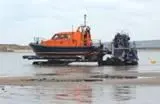
These trials tested the entire system in demanding conditions and were held at Hayle, Cornwall, UK, which experiences regular Atlantic swells. The new L&RS design met all the requirements of the prototype specification and exceeded expectations during the trials; lifeboat crew feedback is now being used by the RNLI and Supacat to refine the pre-production design.
The new prototype all-weather lifeboat, designated FCB2 (Fast Carriage Boat 2), is being developed by the RNLI to replace its Mersey class lifeboats, currently serving at some 28 stations around the UK and Ireland. Supacat’s L&RS is one of two prototypes under development to launch and recover the FCB2, which has to be transported between the boathouse and the water, safer and simpler. As the FCB2 is launched and recovered bow first, Supacat’s L&RS has a unique feature in that a turntable is built into the boat carriage to rotate the boat once recovered, reducing the time and space needed to prepare for re-launch.
Supacat was contracted to design an entirely new L&RS capable of negotiating the most demanding beaches with steep gradients and gullies or travel long distances over flat sand, shingle or mud, to and from the lifeboat launch site. The advanced Supacat system offers the advantage of automating many of the manual tasks of the older system, thus speeding up launch and recovery and reducing manpower and training requirements. The approximate turnaround time from recovery of the boat from the shoreline to be ready for launch again is typically 10 minutes.
The Supacat L&RS comprises a completely new submersible tractor and powered- carriage combination, for which Bosch Rexroth was selected to supply the hydraulic drive system to the individually powered tracks. The system has computer controlled hydrostatic transmission and permanent 4-track drive provides exceptional traction for climbing steep gradients with poor surfaces, such as loose shingle. The L&RS has proved its ability to operate in heavy surf conditions, and in water at depths approaching 3m. In case of breakdown, the L&RS is designed to withstand submersion in water up to 9m deep. Powered by a Mercedes-Benz V6 12-litre engine producing 422bhp it can reach a top speed of 10.5mph at a gross vehicle weight of approximately 47 tonnes including the lifeboat. The 360 degree rotating cradle on the carriage enables the FCB2 to be swivelled from its recovery position (bow forward) to its launch position (bow aft), in under two minutes. ‘Rubber band’ track belts provide the highest possible tractive effort and are smooth and quiet in operation.
Related Articles
 FISHERIES
 FISHING TECHNOLOGY
 FISHING TECHNOLOGY