





Processing raw crabs in sections improves overall yield
In Norway, crabs are usually sectioned while still alive and then each section – claws, legs and bodies – is cooked separately.
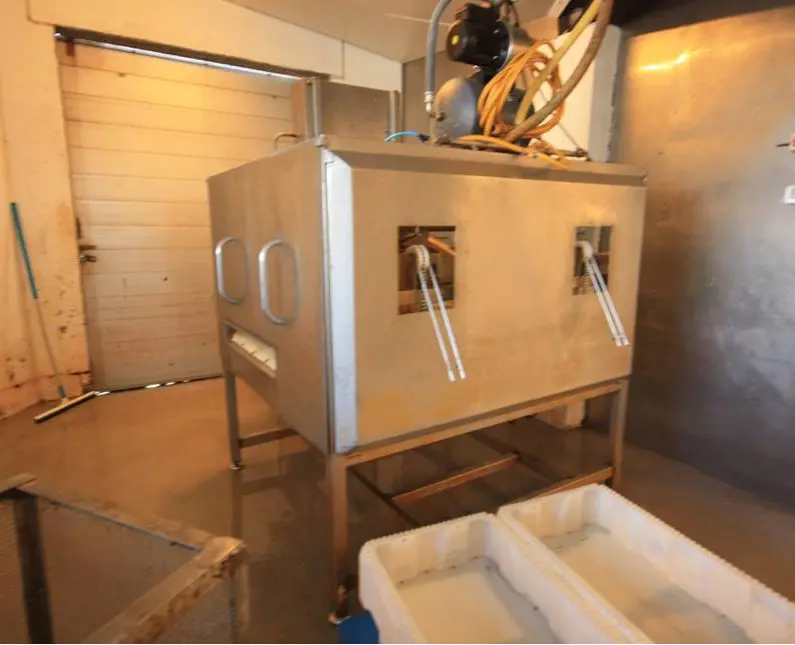
“Compared to the global standard of whole crab cooking, the crab meat yield increase with proper separation and cooking of crab sections is between 10 and 20%,” says Thore Ivar Thorsen, general manager of Snorre Technology AS.
Snorre Technology, located in Haugesund in Norway, has been designing and manufacturing crab processing equipment since 2002, and is now selling third generation machines.
When used for processing the European brown crab, its raw slaughtering machine, with two operatives: separates the claws from the body (this is a semi-manual operation); separates the crab shell from the body; saws off the crab legs proper for extracting the meat; and cleans the purse prior to cooking (this produces white purse meat compared to greyish if the crab is cooked whole).
Other machines manufactured by the company include cocktail claw crushers, crab leg meat removal machines, crab shell washers and spinshellers for removing the meat from the purses. Snorre Technology also offers vacuum claw meat peeling machines, cluster cutters, crab meat presses and claw meat blowers.
The equipment from Snorre Technology has been basically developed for processing brown crab (Cancer pagurus), but several machines have been fitted out for other species including several from North America. “The spinsheller equipment is suitable for most species,” Thore Ivar Thorsen says.
When Snorre Technology equipment is used for processing brown crab, the highest yield, compared to the traditional method of cooking crabs whole, is achieved in the low season, according to Thore Ivar Thorsen. “In the top autumn season the yield difference is just above 10% because the crabs are still relatively full even after a long time of cooking,” he says.
Crabs split into sections consume far less energy to boil than whole crabs, he adds. “In addition to saving cooking time, whole crabs contain a lot of cold water which there is no need to bring into the cooker.
“Also the fresh product expiry date of the extracted crab meat is extended by two more days due to far less manual handling after cooking [previously done in a high risk area of a factory].
“Another major difference is in crab body processing. By far most widely used method is water flotation. You crush the crab bodies and then float out the crab fibres in a large water flotation system. Within such flotation systems, absolutely all crab taste is lost.”
Thore Ivar Thorsen claims that the majority of Norwegian crab processors separate crabs using Snorre Technology equipment. “Norwegian processors also use our spinsheller to take out the crab body meat,” he adds. “The product yield is 50% higher with this technology compared to water flotation.
“Also this meat has not been in contact with water during the extraction process, thus Norwegian processors most often blend this body meat with claw meat. This means that that it fetches a much higher price than flotation grades.”
He believes that crab processors in other countries will convert to the Norwegian system. “But the industry is very traditional so it will take some time before the Norwegian way of crab processing becomes the norm in other countries.”
Related Articles
 PROCESSING & REFRIGERATION
 SEAFOOD
 SEAFOOD