






New packaging extends fish freshness and improves appearance
The world’s biggest Atlantic salmon company, Marine Harvest, has combined two packaging techniques to prolong the freshness of its ASC Salmon Traiteur Loin produced in France.
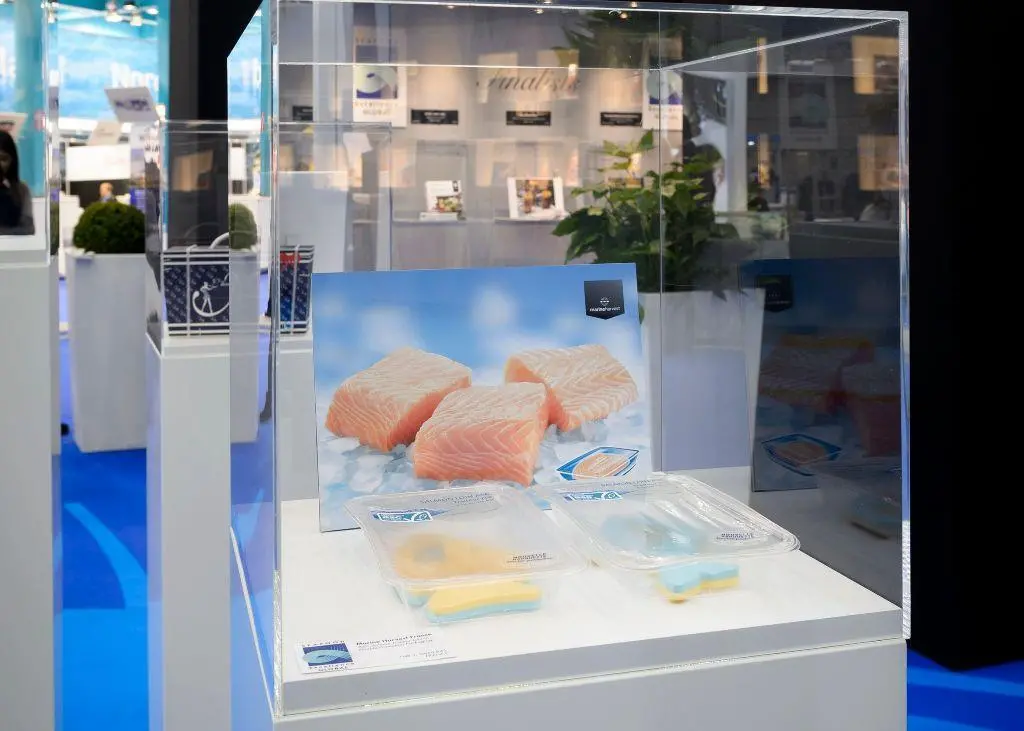
Both modified atmosphere packaging (MAP) and vacuum-skin packaging have been used to keep the fish ‘fresher’ and to improve its presentation in the retail cabinet.
Modified atmosphere packaging is where the air inside a pack is altered to prevent the contents from spoiling as rapidly as they would if the gas mixture had stayed the same. Typically a combination of carbon dioxide, nitrogen and oxygen is used to replace the air.
Carbon dioxide retards the bacteriological spoilage of fish, oxygen can prevent colour changes and bleaching, while nitrogen is inert and is therefore used to dilute the mixture.
The proportion of each gas is fixed when introduced into the pack, but no further control is exercised during storage so the composition of the mixture may slowly change. MAP is sometimes mistakenly called controlled atmosphere packaging (CAP) where the gas combination inside a pack is continuously controlled throughout storage.
CAP can, and is, used in large storage units, but is impractical in small packs.
Dr Don Cann of the former UK government fish technology research laboratory in Torry, Aberdeen, stated that for white (non oily) fish, scampi (nephrops), shrimp and scallops a mixture of 40% carbon dioxide, 30% nitrogen and 30% oxygen gives the best results. For salmon, trout, oily fish such as herring and mackerel, and for smoked fish products, a mixture of 60% carbon dioxide and 40% nitrogen is recommended.
Dr Cann is at pains to point out that MAP is not a substitute for poor storage and only the ‘freshest’ fish should be packed in this way.
“Only the highest quality fish should be used for modified atmosphere packs to gain the most benefit from any extension of storage life,” he wrote. “Packing fish in a modified atmosphere is not a means of marketing medium quality or poor quality fish.”
For the Marine Harvest ASC Salmon Traiteur, for which the company was awarded the top prize for retail packaging at Seafood Expo Global in Brussels at the end of April, the salmon loin was first skin-packed with a gas-permeable but liquid proof film. An additional film was then applied and modified atmosphere added between the two films.
This ‘double protective’ packaging has a number of benefits, according to Marine Harvest:
- The fish is fixed in the pack which allows for upright positioning on the shelves and a better presentation of the fish
- Any moisture leaving the fish during its shelf life is ‘locked’ around the fish, so there is no ‘puddle of moisture’ which can be caused by the use of carbon dioxide in the packs
- The fish looks good thanks to its direct coverage by the shiny transparent film
- The MAP gas mixture between the permeable skin film and non-permeable top film ensures the best quality of the fish throughout its shelf life
This method of packaging must add to the cost of the product and whether the improved shelf life and appearance, claimed by Marine Harvest, has resulted in extra sales hasn’t been mentioned.
Related Articles
 PROCESSING & REFRIGERATION
 SEAFOOD
 SEAFOOD