


Associate Professor Roger B. Larsen from the Norwegian College of Fishery Science, University of Tromsö updates World Fishing on the College’s latest hauling system.
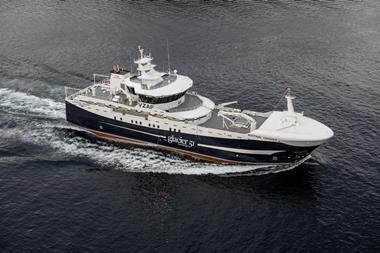
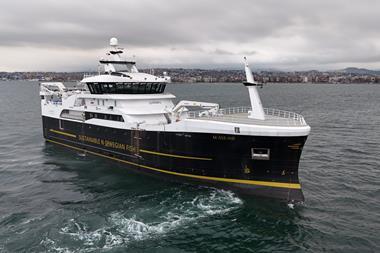
During December 2006 the prototype of a new system for hauling the longline was tested on board the 51m autoline vessel M/V “Loran”, from Godøy near Aalesund.
The experiments were made during rough weather conditions in the Barents Sea targeting cod (Gadus morhua), haddock (Melangrammus aeglefinus) and Greenland halibut (Reinhardtius hippoglossoides). Typically, the larger vessels inside the Norwegian autoline fleet (ca. 40 boats today) use a set of (long)line comprising 50,000 hooks with a hook distance of 1.3m and an 11.5mm PES main line in a Mustad & Sons autoline system. Hauling speed in this fishery is usually in excess of 50 hooks/minute and may last 14 -16 hours for the whole line set. Catch rates varied, but averaged 14 tonnes of fish (including by-catches) per day during the trial period. The results are only published in Norwegian so far.
The focus during the trials was to test whether the new hauling system would improve the ability of bringing the fish on board compared to the conventional hauling method, i.e. reducing loss of fish and unaccounted mortality. An initial study on fish quality was also made. In a broader perspective the results are of importance for the future management of the North-East Atlantic fisheries. Apart from Norwegian fisheries, the autoline (mechanised longline) vessel technology is used by fishers from Iceland, Faroe Islands, North and South America.
Conventional mechanised longline fishery
In the conventional operation of an autoline vessel every fish has to be lifted on board by a gaff during the de-hooking process. Especially during rough weather and at higher fish densities some fish are lost during the process. It is commonly accepted that a high proportion of these fish will not survive and hence be classified as ‘unaccounted mortality’, i.e. usually attacked fatally by sea birds before they recover. Average losses by numbers of cod were 5%, haddock 12% and Greenland halibut 15% during the experiments with the conventional hauling method. Professor Larsen says that they have reason to believe that these numbers are representative for the fleet.
The crew of the boat pointed out that the position in the hauling hatch working with the gaff is seen as very hard labour as they are often exposed to wind and sea spray. Usually the boys are interchanged every 30 minutes. During rough weather conditions the open hauling hatch may be a safety issue.
The new hauling system
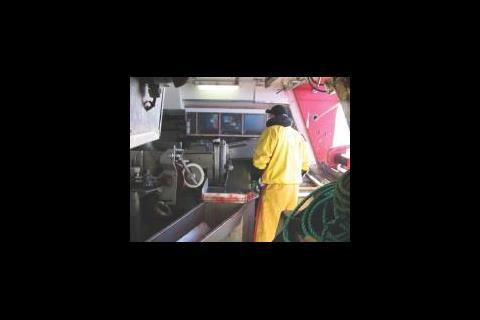
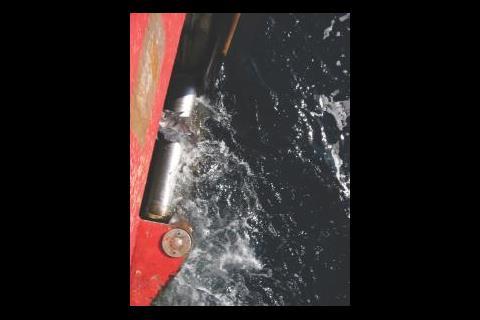
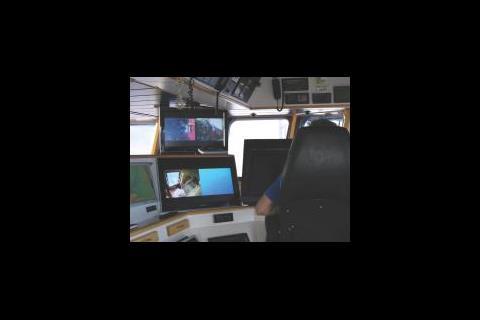
The M/V ”Loran” was rebuilt at Solstrand yard (Tomrefjord) in November 2006 and the new hauling system was integrated into to side of the vessel. The main line is hauled through an adjustable hatch at the waterline. Fish are de-hooked inside the closed system at a roller. Fish falling of the hooks before reaching the roller are caught inside the well and transported to the bleeding station. The gaff is removed and line caught fish are no longer exposed to gaff marks, which reduced quality and outcome during fillet production. The hauling process is monitored by four video cameras and each fish can be followed from the moment they are ca. 10m below the vessel, as they enter the hauling hatch, as they enter the hauling well for de-hooking until they are at the bleeding table. Four video monitors in the wheel house make it easier to navigate and guide the main line and fish on board. In the hauling room the operator (the former ‘gaff man’) can follow similar cameras/monitors and concentrate on treating fish one by one as they enter the bleeding table. If weather conditions are too rough, the normal hauling hatch can be closed during operation.
The experiments show encouraging results. The effective loss of fish was significantly reduced showing values of 1% for cod, less than 2% for haddock and well under 1% for Greenland halibut. Professor Larsen says that they have reason to believe that these numbers might improve as the crew gradually gets used to working with the new hauling method.
The potential of the technology
The results clearly demonstrate that ‘unaccounted mortality’ in the longline fishery can be minimised. From a quality point of view only hand-lines and pots could compete with the longline fishery, but not in efficiency. With the new hauling system fish are brought on board alive and undamaged (except the hook marks in the mouth) and they are treated carefully and bled one by one. Combined with a good system for bleeding the fish before processing and freezing, only high quality fish will be landed. Initial studies on outcome show that fish caught with the new system and correctly treated on board gave perfect loins and fillet products. The outcome in the production also increases as the fish muscle is no longer marked from the gaff, reducing quality and outcome.
The new hauling system will increase the efficiency in the longline fishery. Both fishers and management will benefit from reduced loss of fish during the hauling process. It is not rocket science to calculate that an increase by several per cent of fish brought on board will be of significance for the fishermen working with strict, limited quotas. The gain in efficiency could also be regarded as time saved, fuel saved, bait saved, etc.
For the crew the most evident change from the conventional hauling method is the operation inside the hauling room. It is no longer necessary to stretch out of the hauling hatch to gaff de-hooked fish. Instead the operator can concentrate on improved fish handling and the work is now regarded as a lot easier. During rough weather conditions the conventional hauling hatch can be closed leaving the operator completely sheltered.
Further trials
Researchers at the Norwegian College of Fishery Science are planning extended data sampling from the longline fishery, and two more test periods during 2007 will be made. In these trials researchers will also increase the effort on quality studies.
Facts about the system
The new longline hauling system builds on an idea from the company Delitek of Vesteralen (Northern Norway), who won a prize at the Nor-Fishing 2004 for the development of the automatic longline hauler for small, coastal line vessels was built by Solstrand yard at Tomrefjord and during the process the crew of M/V “Loran” participated. The hauling system is built into the side of the vessel and consists of an adjustable hauling hatch at the waterline, a well for the incoming line and fish and a conveyor belt to the bleeding station bringing any fish falling off before reaching the de-hooking station. The hauling process is monitored by four video cameras and four monitors in the wheel house. Camera 1 shows line and approaching fish under the boat. Camera 2 monitors the entrance of the hauling hatch from the outside observing fish as they break the surface and enter the well. Camera 3 is placed inside the well to monitor fish picked up by the conveyer belt. The last camera monitors the working station inside the hauling room. The videos from Cameras 1, 2 and 3 are also displayed in the hauling room.