

Managing fleets and fisheries
European fisheries are under pressure. Many commercially important fish stocks are declining and so are the number of fishing boats and people employed within the fishing industry. Management and regulation of fisheries are becoming continuously more complicated. Stakeholder confidence in existing assessment and management models is shaken and more efficient management regimes are called for.
Existing models in fisheries management advice (FMA) only consider effects of overall fishing on single fish stocks, while not taking broader ecosystem, social and economic impacts of management decisions into account. Mixed fisheries aspects where several fishing fleets fish on several stocks in the same fishery, spatial planning, and long-term management strategy evaluation are also not considered adequately.
In response to this situation, managers have launched new programmes aiming to develop alternative management evaluation tools and management strategies that have broader, multi-disciplinary and long-term perspectives. These include social and economic impacts and ecosystem impacts (e.g. by-catch and discards) besides biological consequences on single stocks. Consequently, a new trend has emerged in thinking international fisheries research and FMA by developing conceptual and comprehensive multi-fleet and multi-stock bio-economic simulation tools and management evaluation frameworks (MEF) being spatial and seasonal explicit. A successful implementation of ecosystem, social and economic dynamics and factors on a spatial scale in the advisory process is a major leap towards more holistic and sustainable management within EU waters and fisheries. Furthermore, MEFs enable higher degree of participatory management evaluation by involving various stakeholders in FMA.
Scientific basis and development
Results from multiple international and national European research projects are summed up and joined in the paradigm shift approach in thinking and practising FMA. The current advisory system was evaluated to improve allocation of resources according to use and cost-efficiency. Specific EU-policy shortcomings were studied to devise means for their rectification and methods for defining and characterising fleet and fisheries dynamics were developed. Technical developments and efficiency increase over time in fishing fleets (e.g. gears and vessel equipment), as well as patterns and developments in fleet and fishermen’s behaviour were evaluated in several projects. From this knowledge, new programmes focused on developing MEFs able to consider broader bio- and socio-economic effects of alternative management options before potential implementation, and to more directly investigate broader dynamics of the system, i.e. fishing fleet dynamics. This is needed for development of multi-disciplinary models combining traditional management procedures with subsequent responses by fishing fleets and fish stocks (TECTAC, CAFÉ). The arising inter-disciplinary trend also includes key elements in multi-annual management strategies and making these acceptable to fishermen and optimising their commitment and compliance with regulations.
Another important aspect is the development of advisory models enabling an ecosystem based approach to marine management and spatial planning, also addressing dynamics of fleets and fisheries. Socio-economic objectives are included by considering biotic, abiotic, and human components of influences on ecosystems and through an integrated approach to fisheries within ecologically meaningful boundaries. Focus is on spatio-temporal closures and more selective fishing gears to minimise negative ecosystem impacts by protecting certain habitats and to reduce un-intended by-catch and discard of certain species and sensitive life stages. Spatial explicit management evaluation and advisory tools on fleet basis were developed in EU-FP6-PROTECT-513670 and EU-FP6-EFIMAS-502516.
To facilitate better fisheries management regimes, recent projects (e.g. EFIMAS) use state-of-the-art knowledge to develop actual and holistic operational MEFs. Being the largest among a string of recent EU supported research projects, the Danish (DTU-AQUA) coordinated EFIMAS project exemplifies the development of the new concept and evaluation tools in FMA and how scientific advice is likely based in foreseeable future (http://efimas.org; http://flr-project.org; http://wiki.difres.dk/efimas/doku.php?id=efimas;).
State-of-the-art knowledge base
A major challenge is to synthesize the best possible worldwide knowledge to develop European relevant MEFs with broad coverage of main current and emerging management problems and issues. Initially, EFIMAS participants reviewed the state-of-the-art knowledge base for different basic and existing fisheries management systems of relevance for Europe including their institutional set-up and synthesized this in a book-publication, The Knowledge Base for Fisheries Management (ELSEVIER 2006). This includes generating advice for fleet based, ecosystem based, and participatory management in cooperation with multiple stakeholders.
This synthesis was used in a feedback process to develop the MEFs including fishermen and other stakeholder perspectives. Lastly, the book focuses on management scenario modelling and methods and their central role in future EU FMA. Based on the book conclusions on needs to improve current management and advice the developed MEFs were made flexible enough to include a broad range of options under alternative systems.
Platform for management evaluation and advice
EFIMAS, and sister projects, developed and integrated a set of new and existing software tools and simulation models, generating a more robust Management Strategy Evaluation (MSE) framework that allows testing plausible hypotheses about dynamics of fish stocks, fisheries and fleets. The MEF contributes to a conceptual change and paradigm shift in generating advice and management with entire fleets and fisheries as the central units. Here the basic management instrument is the input, i.e. the capacity of fishing fleets in form of number, size and efficiency of the vessels, and their fleet and fisheries based effort (activity). This differs from the traditional output based ICES approach providing advice on single fish stock catch limits from rather uncertain terminal year stock assessments and under strong assumptions on future total stock fishing mortality (F), without much consideration on factors creating and controlling F and partial Fs by fleet. The developed frameworks allow simulating and evaluating, respectively, the biological, social and economical consequences of a range of proposed management options and objectives within different management regimes.
Managing fisheries in a virtual environment provides more reliable scientific advice to stakeholders: In the same way that a pilot might fly in a simulator before flying for real, the simulation tools evaluates the robustness of alternative strategies and virtual regimes to give more holistic FMA in broader context before implementation. This provides managers and stakeholders a better idea of the consequence of a given strategy or intervention before opting for a particular management approach.
To accomplish this, EFIMAS involved 30 European universities and research institutions covering fisheries biology, economy and sociology, and established a multi-disciplinary scientific network of excellence.
Developing a management evaluation framework
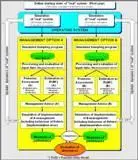
In particular EFIMAS has: (i) Used and developed computer based models that can run stochastic simulations incorporating data from selected EU fisheries and stocks considering fleet interactions, and (ii) through scenario evaluations compared the performance a range of current and emerging EU management options under alternative management systems and objectives (Fig.1).
Fig.2 shows a conceptual box flow diagram of the overall simulation module. The input data is generated by a descriptive model (operating model), which is assumed to represent the ‘true/real’ system. The input data is then processed by a traditional or an alternative fish stock or fisheries assessment model or economic fishery model (knowledge production model), which is used to generate FMA.
By simulating the effect that the resulting management actions would have on the true/real system it is possible to generate a range of performance measures, covering the resource as well as the fishery. These measures enable comparison of a range of options under alternative systems and objectives under consideration of uncertainties in all of the processes.
The developed MEFs can evaluate fleet and mixed fisheries interactions and fisheries behaviour (see box). They evaluate uncertainties in stock and fisheries dynamics, data collection, assessment, modelling, as well as the advisory, management and implementation processes. Being capable of evaluating the relative performance of multiple alternative options the MEFs possess strong capacity in performing sensitivity and risk analyses of consequences.
Evaluation of framework performance
The overall evaluation comprises process evaluation (PE) and technical evaluation (TE). PE focuses on participatory management. Here participatory and iterative scenario-based MEF modelling is used to obtain input and cyclic feedback from multiple (regional) stakeholders for different options, and to test the general utility of the operational MEF during (i) development, (ii) case study applications, (iii) evaluation of case specific results, and (iv) overall efficiency to capture changes in the fisheries systems and the applicability in other stocks/fisheries (general utility).
European fisheries management and advice change rapidly toward a more responsive and efficient system. Increasing stakeholder participation in decision making is central and brings about changes in the role of science. The developed MEFs inform an exploratory and adaptive decision-making process enabling science-based policy even when uncertainty is high.
Participatory modelling does not substitute for using science to set limits, but can focus on crafting strategies and force stakeholders to clarify their objectives and explicitly address the trade-offs implied by various strategies. MEFs facilitate collaboration across disciplines, ensures that models and software are easily validated, and widely available. The main MEF is an open software source (http://www.R-project.org) promoting transparency and allowing technology transfer and development internationally and across disciplines. The software aims at user-friendliness when experts are to implement it in cooperation with stakeholders. As such, the suite of projects has helped to restore the somewhat shaken trust of stakeholders by incorporating a wider range of variables to illuminate the decision-making process and make it more accessible to them.
Technical evaluation
TE includes built-in facilities, capabilities and utilities to evaluate uncertainty, errors, sensitivity, robustness, predictive power and limitations in use through rigorous tests of validity of assumptions and hypotheses on processes and states of the resource and fisheries systems. Further, TE includes MEF utility in terms of technical requirements for set-up and use.
Project results and dissemination as examples
The MEFs have been continuously tested in several cases covering important EU fisheries, areas, and a broad variety of existing and world wide emerging and innovative management options and systems to illustrate the capacity of the MEFs. This covers regulation by traditional TAC (Total Allowable Catch) including possible catch misreporting, multi-annual TACs, direct effort control and decision rules systems, indirect effort control through spatial and temporal closures, rights-based approaches (e.g. individual transferable quotas) and participatory governance, as well as use of different stock assessment models or models for economic dynamics.
The use covers many ICES stock assessment and mixed fisheries working groups, EU STECF working groups, EU RACs (Regional Advisory Councils), NAFO Scientific Council working groups, ICCAT and IWC working groups, and dissemination through many scientific peer reviewed papers, conferences, user courses, and workshops under EFIMAS.
Future perspectives
Future perspectives are to fully integrate the MEF in standard ICES and EU (STECF) management advice procedures and implement participatory and scenario based modelling in proper institutional context with advice from the established multi-disciplinary scientific networks of excellence and research platforms. Also, the aim is to develop and design the flexible MEFs further towards new processes and approaches including ecosystem based management advice considering biological interactions to comply to anthropogenic effects on the entire ecosystem and climate induced effects. As such, the MEF(s) can be used to define new status and management indicators and precautionary limits according to induced changes when evaluating management scenarios. Such integrated modelling will be the new generation of management advice and bring it to the next level.
Acknowledgements cover the significant contributions by DTU-AQUA, EFIMAS and COMMIT colleagues to this development. For more information visit www.aqua.dtu.dk or email rn@aqua.dtu.dk, mol@aqua.dtu.dk