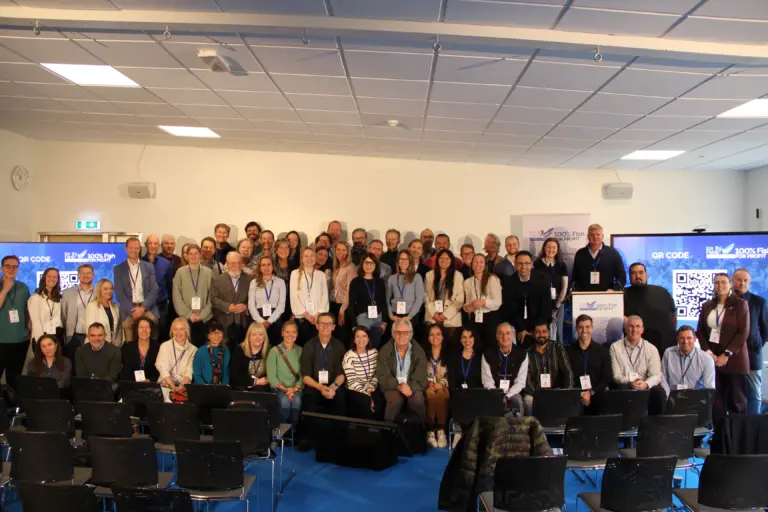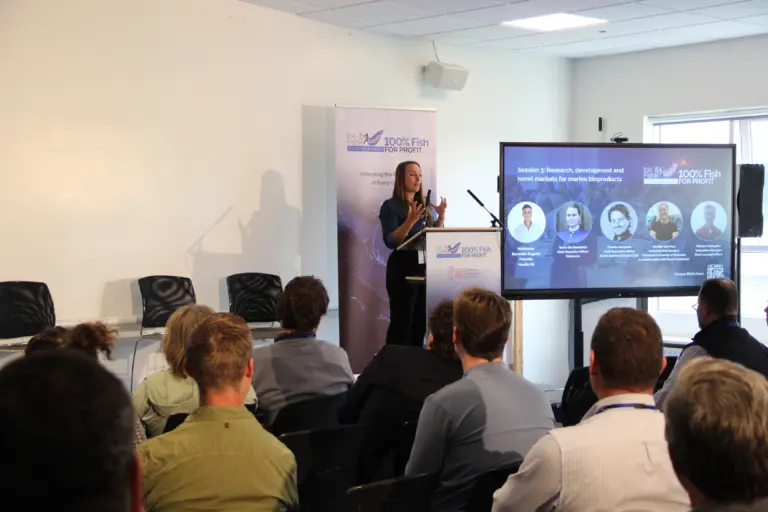
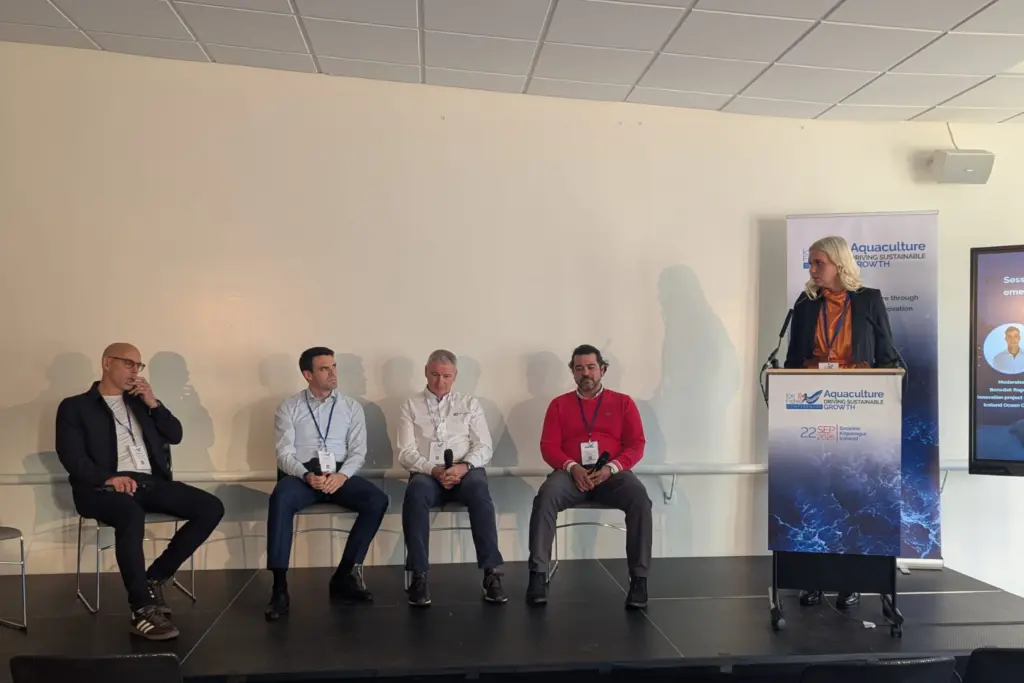
Magnus Thor Asgeirsson, Order Winning Manager, for NP Innovation started the last session of the conference, focusing on investable infrastructure and resilient aquaculture.
He looked in detail at water treatment for aquaculture, considering optimizing filtration in 5 steps, target separation, type of filter, filter media, filter process, flushing and the whole of the RAS loop.
He introduced water quality results from BioGuard FLO trials at Nordlax, demonstrating how advanced filtration can reduce water and energy use while improving operational reliability in aquaculture.
Stewart Graham, Owner & CEO of Gael Force, outlined the SeaQureFarm concept, designed to improve fish welfare, production efficiency and environmental performance in marine aquaculture.
He explained that the system combines contained SeaQureWell pens with controlled water flow, oxygenation, monitoring and waste collection. Biological and financial modelling, material testing and advanced computational fluid dynamics have been used to optimise the design for different sites and species.
He concluded in outlining potential applications which could include post-smolt production and increased at-sea production, with improved survival and welfare alongside protection from predators and sea lice.
“Unlocking Hidden Production Capacity Through Better CO₂” was the third presentation of the afternoon. Drawing on commercial farm data and an ongoing research project Eivind Farestveit Larsen, CEO of Searas AS demonstrated how improved CO₂ removal and reduced gas pressure can enhance fish welfare, increase production capacity, and lower energy consumption.
He showed that, “To control CO₂, you must understand the full carbon balance, carbon input ≈ carbon removal + accumulation.”
He also made a valuable financial point, “When degassing is insufficient, operators pay elsewhere –
- More water
Higher pumping, heating, and treatment cost
- More chemicals
Higher buffering cost and complexity
- Less feed
Lost growth and production
Eivind ‘s messages were, “If you do not know the carbon balance, you do not know the actual production capacity. CO₂ shows the condition now, TIC reveals the total carbon load, Mass flow proves the removal capacity. “
And finally, “Better carbon management can unlock more production from infrastructure that has already been built and paid for.”
The final presentation at the first IceFish Aquaculture conference was “Accelerating applied innovation in re(generative) aquaculture in Latin America.”
Ernesto Rodriguez Leal, Executive Director at the Center for Applied Aquaculture Innovation, led with the statement, “It’s important to measure the impact of regenerative aquaculture”
He went on to discuss, “Why is Aquaculture strategic?”, offering this quote from the World Economic Forum 2024 and World Bank 2024–2025, “Investing in blue foods strengthens coastal economies, climate resilience, and community wellbeing aligning with territorial development and conservation priorities.”
He then went on to use La Paz in Mexico as a case study for the development of Aquaculture, ” La Paz has a strong foundation to become a leading hub for aquaculture innovation, with prestigious educational institutions, scientific research, and industry collaboration. A diverse range of stakeholders are working on aquaculture-related topics across the region, from scientists studying marine ecosystems to companies developing new technologies for farming fish and shellfish in the open ocean.”
Ernesto introduced the work of the Center for Applied Aquaculture Innovation (CAAI) whose mission is to create applied solutions that build resilient systems and accelerate integrated solutions in (re)generative warm-water aquaculture to contribute to food security and healthy oceans for current and future generations.
He explained that the CAAI will serve and foster collaboration between stakeholders and also revealed that it is now part of Innovaciones Alumbra Collective, an ecosystem of organizations committed to demonstrating and catalyzing economic growth models that restore nature, strengthen communities, and foster long-term health and prosperity.
He then described the CAAI Collaboration & Innovation Ecosystem, Finfish Research Program, and Bivalve species development program.
In addition to these valuable programmes the CAAI also engages in Workforce development and encourages Entrepreneurship.
Finally, Ernesto revealed the exciting plans for its expansion and future – a positive way to draw the presentations to a close.
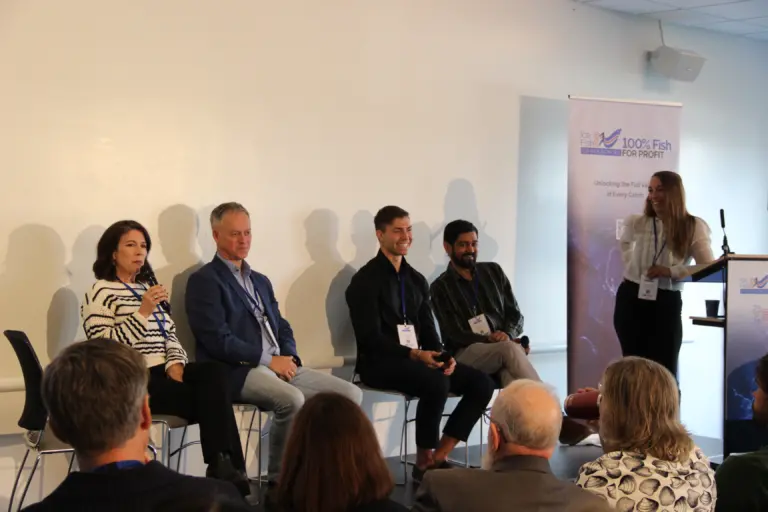
Speakers then fielded questions from the audience, with some final wsie words, Magnus Thor Asgeirsson saying, “the biggest challenge is scaling up processes” and Eivind noting ” You need to have the finance to be able to fail before you succeed.”
As the Chair, Ólöf Helga Jónsdóttir brought a successful Aquaculture conference at IceFish 2026 to a close she commented, “We came looking for ideas to pass on and this was just what the conference delivered…”