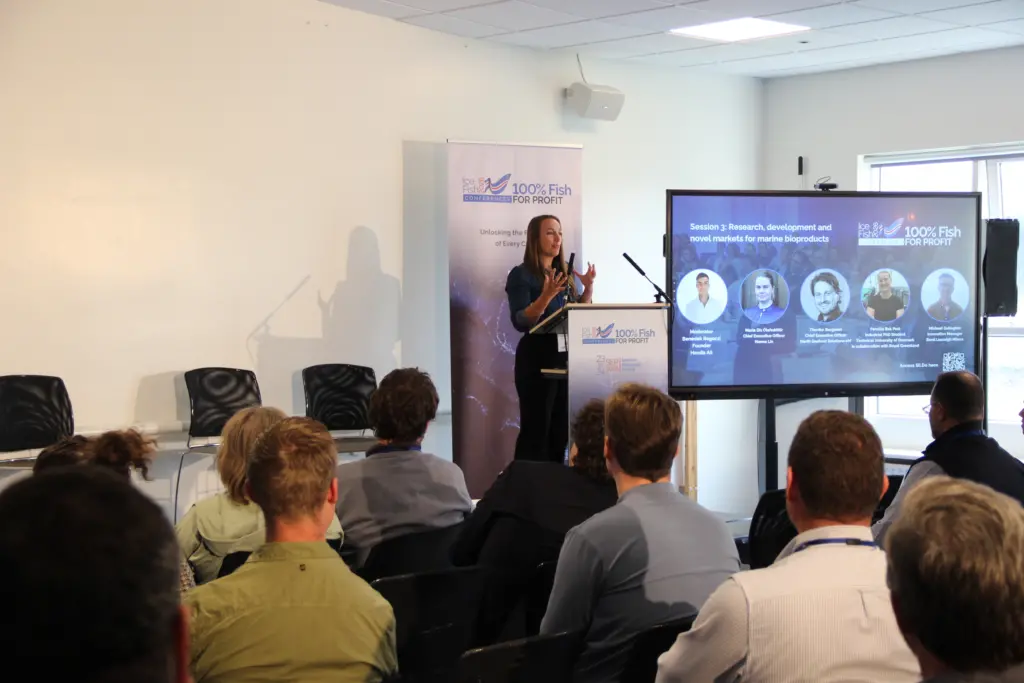
Local entrepreneur, María Dís Ólafsdóttir, CEO, Nanna Lín, started the session with a discussion with the question, “How far can you go on favors?”
She explained that she is applying the fishing industry’s full-utilisation philosophy to leather production, developing a concept designed to maximise raw material use and minimise waste.
She has had to address challenges including material size limitations, imperfections and discarded leather offcuts and did this by developing leather sheets so that all the raw material gets used.
Maria stressed that you must understand every component of the raw material and know the difference between favors and business deals, something she has had to learn along the way.
Summing up Maria said, ” It’s a crazy idea and something completely new, so with that means a lot of research! Our biggest problem is access to material; we need the market to know that we can use what they do not want. We no longer want to work from favors but secure business deals.”
Seafood processors should look “beyond fishmeal” and turn side streams into higher-value products for cosmetics, nutraceuticals and medical applications, according to Thordur Bergsson, CEO of North Seafood Solutions in the second presentation of session 3.
He said, ” We have 40+ years’ experience in clean cold enzyme extraction, pioneering the way in Iceland, being 100% focused on side streams. The future is looking very bright, but there seems to be a gap between the academia and research projects, with differences in realities of what the industry looks like.
Thordur said that while fishmeal enables high-volume utilisation, “100% utilisation ≠ 100% value” thermal rendering can destroy fragile bioactive peptides and natural collagen structures capping financial return.
He highlighted other opportunities which include nutraceuticals and cosmetics, medical & biomaterials such as 3D printed scaffolds, tissue matrices and bio-implants.
However, he stressed that high-end applications cannot absorb all available side streams, meaning processors need to combine premium markets with bulk commodities – “100% value comes from combining all four sectors not just picking one, medical, cosmetics, food and bulk commodities.”
“The technology is not the bottleneck,” he said. Instead, achieving greater economic value depends on processing-floor discipline and supply-chain partnerships. Raw material quality is critical because “material that has begun to spoil cannot be recovered”
A new research project which aims to transform thousands of tonnes of Greenland’s shrimp processing side streams into valuable protein, oil and chitin products was the subject of the third presentation.
The UP-Green project, an industrial PhD collaboration between Royal Greenland A/S and the Technical University of Denmark (DTU), is investigating greener ways of utilising shrimp heads, shells and legs.
Project researcher Pernille Bak Post said the aim is to recover and valorise protein, lipids and chitin “in a greener and more sustainable way.”
Pernille said it is not without its challenges, ” Geography is key when working in a country that does not have any roads connecting the local towns… so to process our side streams, the catch needs to leave and arrive to the facilities by sea.”
She showed how a single processing factory can generate 7,000 to 10,000 tonnes of side stream annually. Instead of producing conventional shrimp meal, researchers are exploring fractionation using “a non-chemical and low energy requiring method.”
She went on to point out that further processing could produce an ingredient containing 60% protein and 0.8% chitin, alongside “a pure shrimp oil rich in astaxanthin”.
Future salmon feeding trials will assess digestibility, feed economics and fish quality, while the project ultimately hopes to create local jobs and support a more circular Greenlandic seafood industry
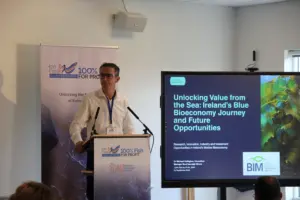
Ireland has the resources and expertise to become a global leader in the blue bioeconomy, according to Dr Michael Gallagher, Innovation Manager at Bord Iascaigh Mhara (BIM), the Irish State agency responsible for developing Ireland’s seafood sector, supporting sustainable growth across fisheries, aquaculture and seafood processing.
In the final presentation of the day, Dr Michael started by saying that he and his colleagues, “…are currently absorbing what all the opportunities are that we have learnt from the past few days and it is all very exciting.”
He then highlighted opportunities to transform marine biological resources into higher-value products spanning health and nutrition, sustainable materials, agriculture, cosmetics and pharmaceuticals.
He defined the blue bioeconomy, “…transforms marine biological resources into sustainable products, materials, food, feed, health and sustainability solutions” and then went on to say it is, “something that is gaining higher relevance with regards to current trends and that resonates with the audience.”
He told delegates, “A strong innovation pipeline is already in place (in Ireland),” pointing to research in seaweed biorefining, marine bioactives, nutraceuticals, alternative proteins and processing by-products. Significant untapped value also remains within existing marine biomass streams.
Citing Ireland as an ideal country he said, ” Ireland is home to all of the world’s top 10 biopharma companies, 9 of the top 10 medtech companies, and is Europe’s second-largest exporter of medtech products.”
Commercialisation will increasingly depend on international cooperation. “Ireland is seeking partners to accelerate commercialisation and scale,”
Looking towards 2036, BIM sees opportunities for increased biomass valorisation, greater processing capacity and new high-value products, arguing that “partnerships can translate scientific excellence into commercial success.”
Dr. Michel finished on a positive note, “the next decade represents a major opportunity to build a globally competitive blue bioeconomy sector.”
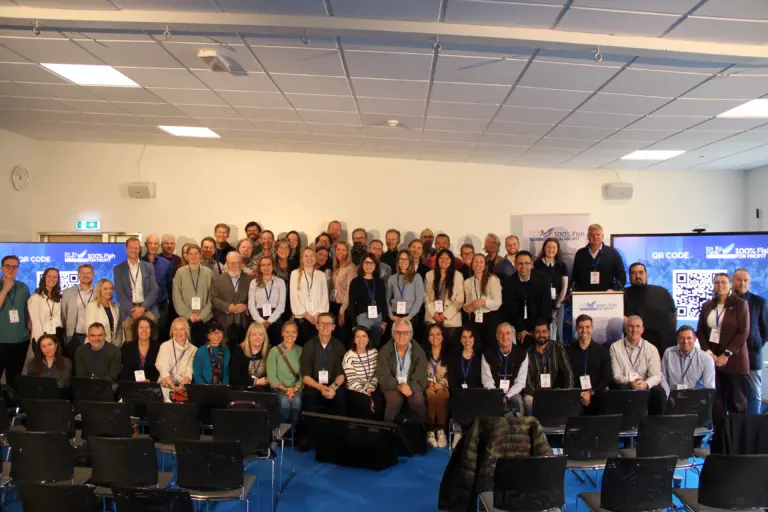
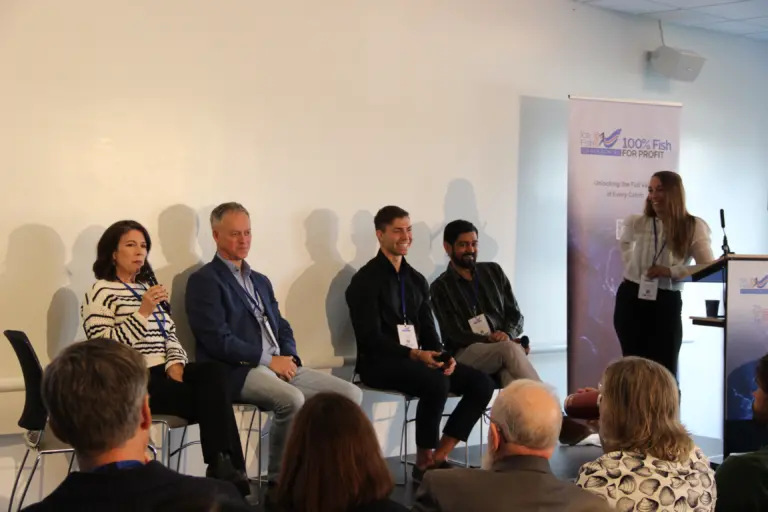
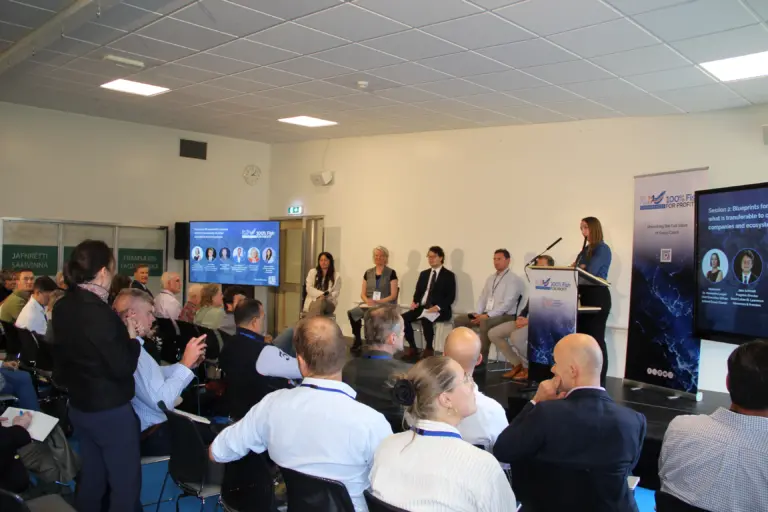
Moderator for the session, Benedek Regoczi, Innovation Project Manager for the Iceland Ocean Cluster, then took questions from the delegates before closing the first day of the 100% Fish for Profit conference.