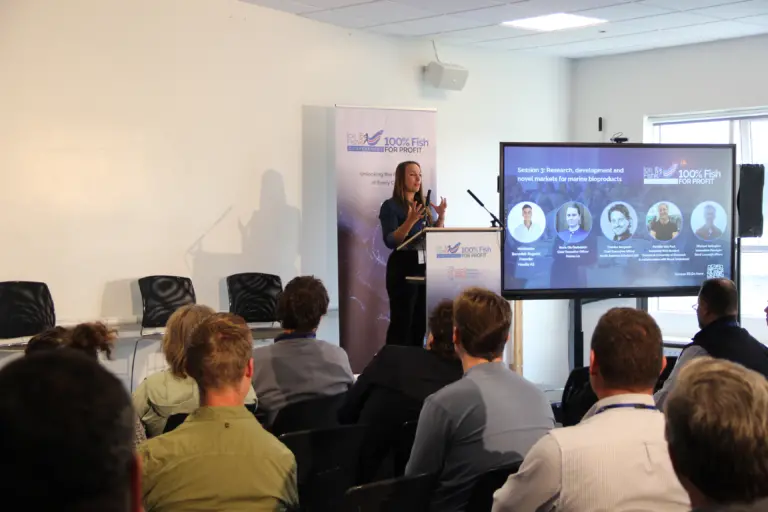
Dr. Alexandra detailed the successful of Kerecis, an Icelandic medical technology company that creates wound-healing grafts from the skin of Atlantic cod and which was dubbed Iceland’s first-ever tech “unicorn”.
She then went on to pose the question, “who’s going to be the next Kerecis?”, before discussing, “how and why they were so successful, how can we replicate it and how do we ignite the next generation on entrepreneurs.”
This was followed by a presentation from Benedek Regoczi, founder of Norwegian biotechnology company, HAVDIS.
He revealed that he had grown up in a family of doctors which meant that at dinner time he, “1) learnt to keep my food down and 2) new innovative treatments can be life-changing…”
 In a presentation subtitled, “Sourcing fish sperm to save lives ” Benedek explained that the company is seeking to turn fish by-products into high-value healthcare ingredients with what it describes as “the world’s first cod-derived PDRN.”
PDRN, or polydeoxyribonucleotide, is extracted from fish DNA and is described by HAVDIS as “a molecule that jumpstarts the body’s own repair process,” supporting new blood-vessel formation, reduced inflammation and tissue regeneration.
The company sees significant potential in chronic wound treatment, noting that 1.5-2 million people in Europe have wounds that will not heal on their own, while wound management accounts for an estimated 3% of healthcare expenditure.
Benedek revealed some stark wound images showing the treatment’s successful effects and handed out samples of products.
HAVDIS plans to supply PDRN directly to cosmetic formulators and pharmaceutical ingredient buyers, using wild-caught Atlantic cod from Norwegian fisheries.
Benedek summed the exciting venture as, ” Rooted in nature, refined by biotechnology.”, going on to say, “We are hoping to move from cosmetic to medical, we are seeking to scale our sperm solutions.”
Alaskan entrepreneur Sara Erickson is the Founder of AlaSkins which takes wild salmon, cod and halibut skins previously discarded by processors and turns them into products including pet treats, meal toppers, canned pet food, halibut oil and skincare. Human-grade fish skin chips are also planned.
She began her presentation by saying. ” My father was born and raised in China and once said to me that the fish skin is the most nutritional part of the fish and this is what has stuck with me all these years, leading me to build Alaskins, the perfect case study on how to do more, even when you have less!
She was keen to tell delegates that “utilization is not the same as high-value utilization,” and she encouraged businesses to find multiple uses for the same raw material.
Sara presented four strong messages,
- Believe in it – Get used to the feeling of panic. Keep moving forward.
- Don’t wait – Do not wait for government, grants, or perfect conditions.
- Make products – One discarded stream can become many high-value SKUs.
- Teach the next generation – If the adults don’t see it, educate the kids who will.
Her final message was summed up simply: “Make pennies a pound, or dollars an ounce.”
The third speaker of the day, Hogne Hallaråker, CEO of Arctic Algae, a subsidiary of Arctic Bioscience, spoke about the concept of fish to pharma, with Arctic Bioscience as pioneers in natural resolution of inflammation.
He introduced the delegates to a study for the treatment of psoriasis, Haukeland RCT Pilot study, “during this study we found out that it (algae) has a very strong impact on systemic inflammation, showing consistent reduction through two clinical trials.”
He also detailed their work in brain development in extremely premature infants and glaucoma.
He then went on to detail the work with algae and the company’s development of a microalgae-based oral vaccination platform designed to make booster vaccination in aquaculture simpler, scalable and less stressful for fish.
” Once salmon have been vaccinated there is no way to provide them with a booster that is not via injection, this is a very expensive and labour intensive process. We want to develop an oral vaccine through feed, to combat this.”
“Our concept is simple, using microalgae to turn feed into immunity,” said Hogne Hallaråker, CEO of Arctic Algae. “The impact is to create a scalable platform for next-generation oral vaccines.”
The final presentation in the first session centered on “Bridging marine to medicine”.
Lalit Rane, co-founder of Há Biotech AS, shared with delegates that the company is developing cutting-edge antibody-based therapeutics to produce reproductively sterile farmed fish.
This will address critical challenges like spawning disruption, fish escapes, and ecological risks.
 It should prevent genetic pollution from escapes, reducing control costs, and supporting the industry in achieving UN sustainability goals.
Há Biotech aims to make fish farming both environmentally and economically sustainable while protecting wild fish populations.
Through advanced immunological interventions, the company’s mission is to transform aquaculture into a cornerstone of sustainable food production, meeting global protein demands responsibly.
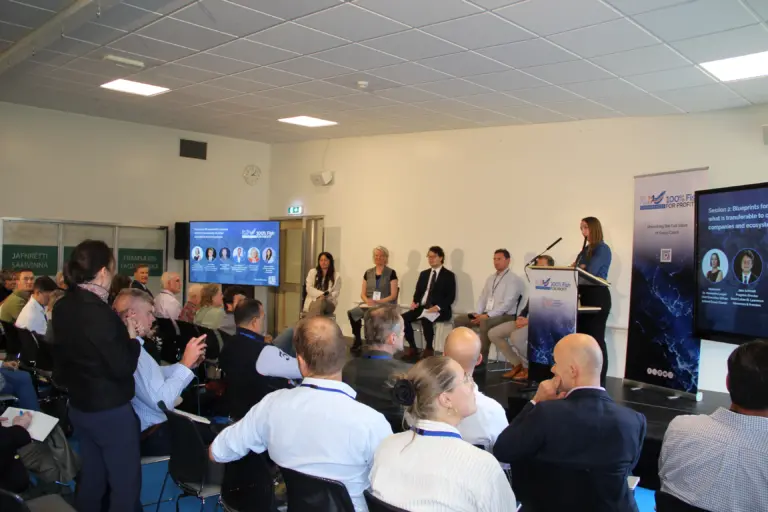
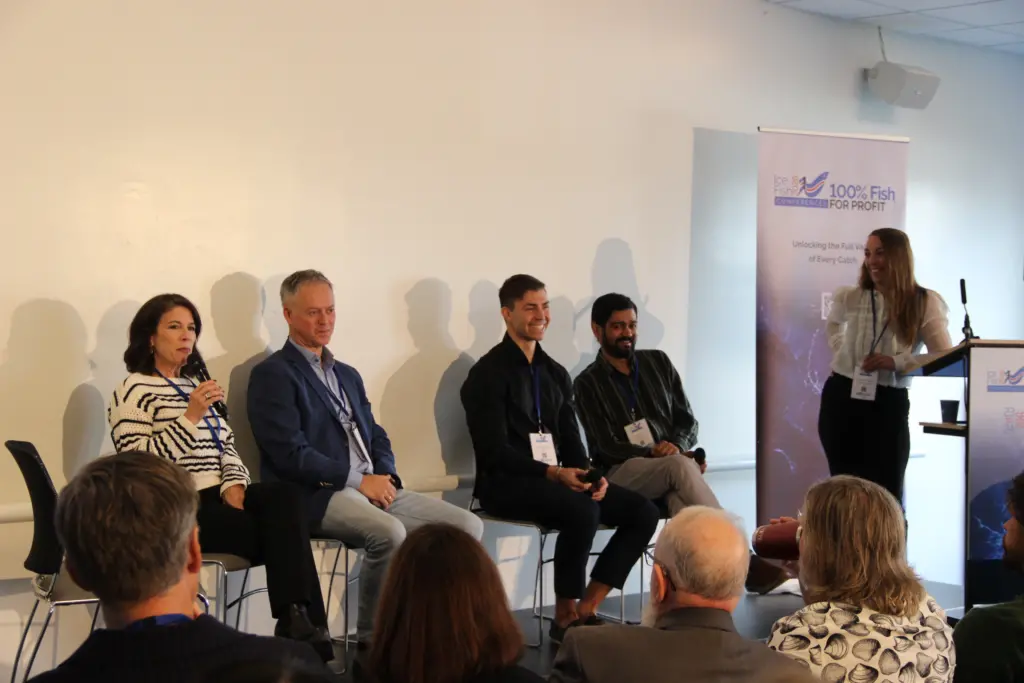
At the end of this final presentation in session 4 delegates had the opportunity to ask questions of all of the speakers, moderated by Dr Leeping.