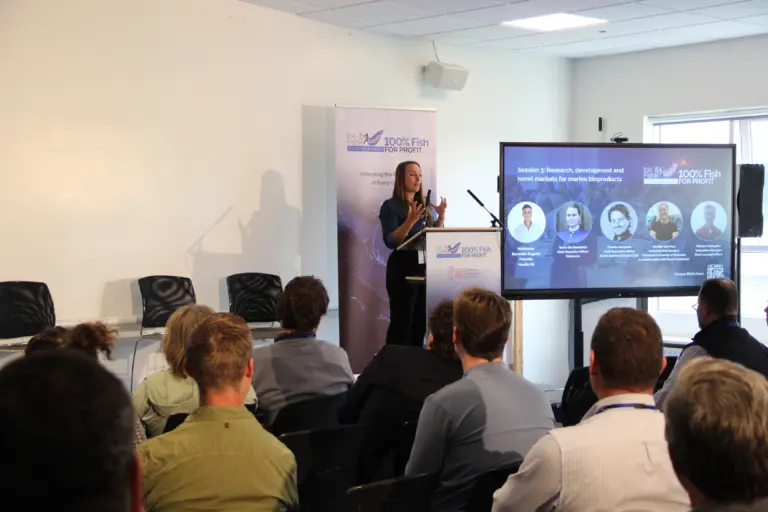
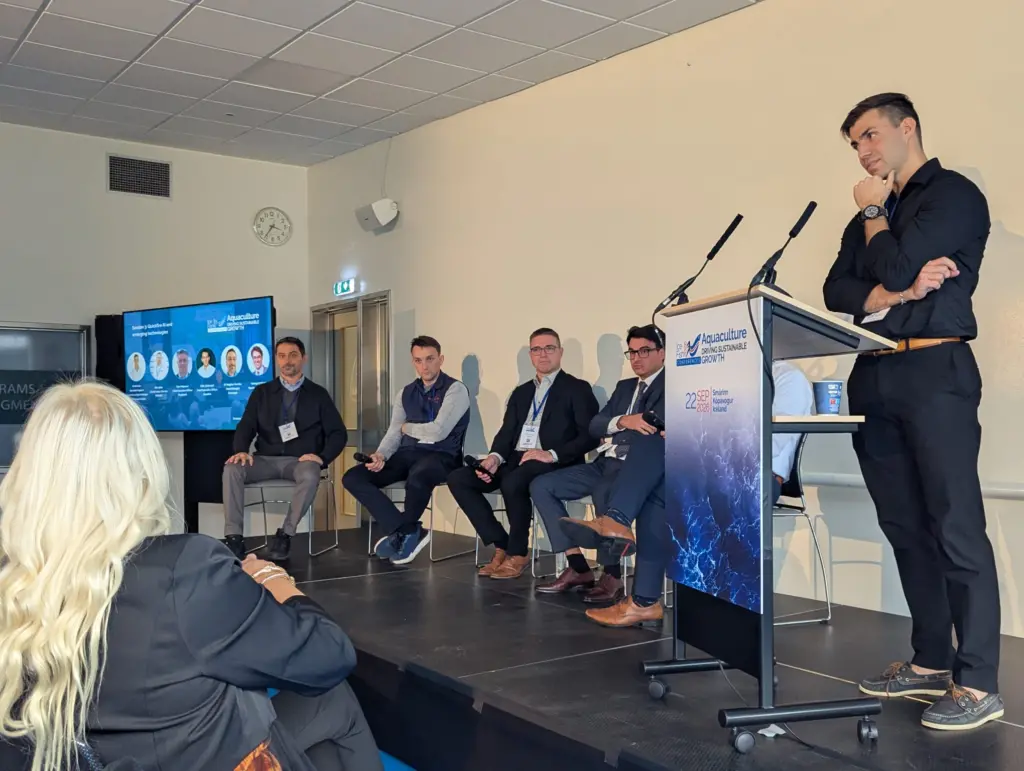
A very popular session 3 of the Aquaculture conference covered new technologies. The session was moderated by Benedek Regoczi.
One of the fastest growing technologies in the Aquaculture industry is monitoring equipment. Paw Peterson, CEO, Oxyguard, looked at how to use this technology to the best advantage, stating “The challenge is no longer simply collecting data. It is turning data into useful knowledge”.
He considered the reasons why monitoring is important, not only to measure but to use those measurements to establish trends, “Measurements + production events + historical trends” help to look at emerging patterns so action can be taken.
A key point in his presentation was “A value tells us where we are. A pattern tells us where we may be heading”, allowing action to be taken earlier than when an event occurs.
Paw introduced the role of AI and offered a fascinating study on the use of AI-powered acoustic monitoring for improved feeding, saying “We have started listening to the fish. Can underwater sound add another layer to understanding fish.”
Nils Rabe, Global Sales Director of Baader, then explored how next‑generation processing systems are reshaping seafood production. He discussed the importance of animal welfare, pointing out that “it is now being demanded through new product policy, becoming mandatory in places such as the UK, and, soon to be, global. He indicated that “processing equipment should support best practices, that’s why we have implemented a new level of animal welfare into our latest stunning and bleeding system BAADER 102.”
Nils also looked to the future where new and perhaps smaller players would enter the market. Baader have been considering breaking down complex processing systems into individual and independent modules to make the processing solution customizable for those newcomers. He said, “The market and technology for Atlantic salmon fishing exist, we believe in modernisation to match the demands of both global players and the smaller guys who are growing their facilities.”
Eirik Lillebudal, CEO of EquaFish presented “Beyond more sensors: making sense of the data fish farmers already have.”
Using a Norwegian Airforce analogy he started by saying, “It’s not the pilot with the best aircraft who wins. It’s the one who understands the situation first. “
Eirik used key findings across audits by the Norwegian Food Safety Authority (Mattilsynet) (2024-2025) data to explain his point in the aquaculture sector:
- Targets follow production.
- Welfare data rarely changes a decision
- Risk management is fragmented
- Little learning from deviations
He finished his presentation advocating “Joining the data is how you find out what is missing”.
Bogdan Vornicu, Head Biologist at Avascope took delegates through the Avascope Solution which fuses biology, technical support life, and physical environment into one operational decision engine.
He went on to explain in detail the three elements of the Solution:
- Macro-Scale Indicators: Daily satellite-derived monitoring tracks chlorophyll-a, turbidity trends, and offshore anomalies.
- Micro-Scale Environment: Real-time in-situ temperature, dissolved-oxygen, algae, jellyfish and microscopic jellyfish, biofouling, nutrients and salinity profiling.
- Biological Observations: Directly analyzing actual fish behavioral shifts, buccal cavity traces and gill health metrics
The conclusion of his presentation was ““Most systems tell you what has happened. We tell you what will happen – and what you could do about it”
The final presentation in session 3 came from George D Mantas, Business Development Director of AquaBioTech Group.
He introduced the development of an AI-based tool for the early detection of environmental stress and presence of Vibrio anguillarum in farmed European seabass Dicentrarchus labrax
He explained that this was a project under “Actions for Climate Transition by developing Future Aquaculture Strategies and Technologies”, known as ActFast. It is a Horizon Europe Innovation Action (GrantAgreement No. 101181159) dedicated to identifying, validating, and demonstrating climate change adaptation and mitigation solutions tailored for European aquaculture.
The development of an AI-based tool for the early detection of environmental stress and the presence of Vibrio anguillarum in farmed European seabass, Dicentrarchus labrax is an ActFast Project Task.
George went on to say that it is needed because,
- ” Vibrio anguillarum is a bacterial infection agent
- Mainly affects marine and freshwater aquatic life
- Causes a fatal blood-poisoning disease in fish, crustaceans, and bivalves called vibriosis
- Is considered one of the most economically devastating bacterial pathogens in global fish farming
- Vibrio bacteria are highly thermophilic, meaning they thrive and multiply rapidly as water temperatures rise.
What followed was a fascinating and detailed insight into the use of cameras and AI for detection and analysis. Limitations were clearly identified as were the eventual successful outcomes.
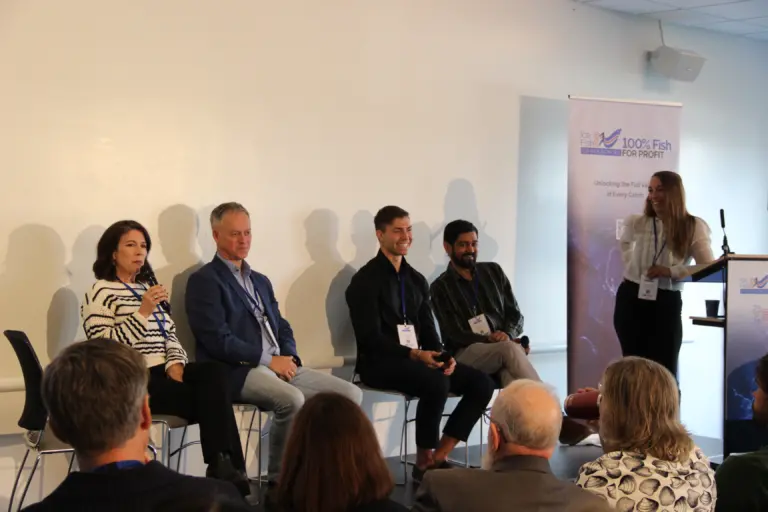
At the end of the session, the speakers all took part in a Question-and-Answer session with Nils Rabe making a sage and pertinent comment, “You have to ask the right questions for AI to give us the right answers…”
This and the other presentations in this session showed the extent and variety of technological work being undertaken to advance the Aquaculture sector.