
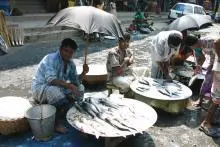
Greater awareness of marine fishery limitations has prompted governments to institute a change in approach, focusing on the rehabilitation of traditional fishing grounds and the development of sustainable fisheries industry. The major growth area for fisheries during the past decade has been in marine and freshwater aquaculture, which are expected to provide most opportunity for fisheries expansion in future.
While fishing is a traditional occupation in coastal countries, actual development of fishery resources varies widely among Asian countries. While some countries such as Thailand have large scale fishing industries that process their catch for export worldwide, others have hardly developed their fishery production potential.
One international organisation that has played an important role in supporting development of fisheries throughout the Asia-Pacific region is INFOFISH, an intergovernmental organisation that provides marketing information and technical advisory services for fishery products.
INFOFISH was established in 1981 by the Food & Agriculture Organization (FAO) of the United Nations with offices in Kuala Lumpur, Malaysia, to serve the Asia-Pacific region. It is one of eight similar fishery support organisations set up by the FAO under its FISHINFO programme to provide fisheries information to different regions of the world.
In 1987 INFOFISH moved out from the FAO umbrella to become an intergovernmental organisation. Today the agency has 13 member countries that pay an annual contribution which covers 15% of its operational costs.
INFOFISH is largely self financing with income generated from activities and services covering 85% of its operating costs.
“INFOFISH assists and provides support to fisheries industry by publishing fishery market prices, linking buyers with sellers, consultancy and other assistance,” explained Tarlochan Singh, chief of INFOFISH technical advisory services, “We also receive assistance from the FAO and external consultants to supplement our in-house expertise.”
INFOFISH has about 10 professional staff, some employed directly while others are seconded from member government fishery departments. In addition to administration, the agency has three other divisions – the technical advisory division, the trade promotion division and the market information division. The latter publishes the magazine INFOFISH International and two newsletters – Fish Inspector and Fishing Technology Digest.
“Many people use our marketing services and get technical advice on aquaculture, fish handling, processing and quality control. We get individuals, companies and governments approaching us,” Singh noted.
“We are helping Pakistan to improve fish handling and to upgrade processing plants so their products can be accepted by importing countries. The government also has requested an overall feasibility study on fisheries including aquaculture, both marine and freshwater.”
“Iran has gone into large scale shrimp farming. The have had disease problems. INFOFISH has been involved in training their staff in HACCP implementation, verification and audit.”
The development of fish processing is a priority for many governments that are keen to maximise foreign exchange earnings from fishery exports. India’s Marine Products Export Development Authority has requested INFOFISH’s assistance to develop value added products for the fish processing industry.
The governments of Bangladesh and Sri Lanka have made similar requests according to Singh.
Technical assistance is provided in various ways. Workshops are one common method. Workshops conducted during the past year in various countries include disease in aquaculture farms; crab culture in Sri Lanka and India; organic fish farming in India; tilapia rearing in Sri Lanka; and milkfish processing in Sri Lanka.
Other assistance can include Pan-Asian initiatives such as the approaching completion FAO-TCP project to set up FishTrade Net, a computer based database in all member countries to facilitate the fish trade, and to assist member countries in fisheries management.
Pakistan, Iran and the Philippines are the most recent new members of INFOFISH, each joining during the past three to four years. Singh pointed out that INFOYU is the sister organisation that covers China and is based in Beijing.
Apart from Pakistan, Iran and the Philippines, other INFOFISH members are Bangladesh, India, Indonesia, North Korea, the Maldives, Malaysia, Pakistan, Papua New Guinea, Solomon Islands, Sri Lanka and Thailand.
“We hope that Vietnam will become a member in future. We are working with them already on projects and conferences,” Singh said, “Myanmar is not a member yet. We are starting an organic aquaculture project that includes Myanmar and hope they will become an INFOFISH member. Cambodia has come to our meetings but is not a member yet. Laos is not a member either. Other potential members are Pacific Island nations, also Australia and New Zealand.”
While INFOFISH exists to promote the fishery sector, the organisation is aware of the need to promote sustainable fisheries development. Singh noted that initiatives within the fisheries industry itself were helping ensure responsible, sustainable fisheries development.
“There has been a lot of concern about over-fishing but there has been an encouraging awareness in last 10 years about this issue among NGOs, governments and other groups,” Singh observed, “Fishery groups have become proactive. For example, the Global Aquaculture Alliance of America is encouraging sustainable and environmentally friendly fish farming. Also, big retailing organisations like Walmart are insisting their suppliers’ products come from sustainable fisheries. Walmart also requests all farmed shrimp it buys is farmed in a sustainable manner.”
“Also, the Aquaculture Certification Council is running a certificate programme for shrimp farms and processing plants that are operating in an environmentally friendly and sustainable manner.”
As part of its information promotion activities, INFOFISH has developed a reputation for organising highly regarded industry conferences and seminars which draw the major players in the industry.
The biennial TUNA conference series, for example, has become a focal event for the global tuna industry. This year’s conference, TUNA 2006 Bangkok, was the ninth in the series and the largest so far, attracting close to 600 participants from all over the world.
INFOFISH is also credited with organising the first comprehensive, business-oriented conference on organic aquaculture, which is a new and fast growing niche market activity. Organic Aquaculture & Sea Farming 2004 was held in June 2004 in Ho Chi Minh City, Vietnam and drew some 250 delegates.
According to Singh, the conference has played a pivotal role in stimulating interest in organic aquaculture in the Asia-Pacific region and elsewhere.
Two major conferences are planned for 2007. TILAPIA 2007, a follow-up to the maiden event held in 2001 in Kuala Lumpur, will be held from 23-25 August 2007 in Kuala Lumpur.
New conferences planned include CATFISH 2007, which will be held in Ho Chi Minh City, Vietnam from June 14-16 2007. The conference is planned due to the increasing role that catfish, especially pangasid catfish, are beginning to play in international trade.
Meanwhile, in a new departure INFOFISH assistance has been requested to organise an ornamental fish session during INDAQUA in India in Jan 2007.
Singh explained that INFOFISH is interested in supporting development of indigenous freshwater ornamental fish such as swordtail, mollies, goldfish and others.
Fishery products are an important source of protein in the diet of many families in Asia. While economic development and rising incomes has resulted in rising demand for higher quality and more expensive seafood products among more affluent sectors of the population, much of the growth in fisheries production, particularly aquaculture, is targeted at export markets.
Fishery exports are an important source of foreign revenue to INFOFISH member countries such as India, Bangladesh which is an important prawn exporter, the Maldives for which tuna is a major export, and Thailand which is the leading tuna canner and prawn exporter.
One recent development in Asian aquaculture that caters to western demand for high quality food products is the spread of organic marine and freshwater aquaculture. INFOFISH currently is preparing to launch a pilot project in several countries to enable organic aquaculture technology to be more widely spread to other member countries.
“Organic fish farming is a niche sector which has seen rapid growth in recent years. Member countries can benefit from the premium prices and boost their earnings,” Singh explained, “In India and countries like Bangladesh and Myanmar, many existing aquaculture practices already are almost organic, but are not certified. We feel that with certification and a few modifications these fish farmers could export at higher prices.”
Organic fish farming does not permit the use of antibiotics, chemicals, genetically modified inputs and other potentially damaging items. Organic compost made from mangrove leaves, seaweed or other similar materials should be used to fertilize ponds instead of chemical fertilizers. The use of cattle manure as a fertilizer is not permitted as this may contain parasites or antibiotics.
“Our project aims to develop export and domestic market for organic shrimp but can also be applied to grant freshwater prawn, tilapia and other aquaculture products,” Singh said, “Malaysia’s Fisheries Development Authority looking at organic fish farming for the Asian sea bass which is a brackish water fish.”
Funded by the Common Fund for Commodities, an intergovernmental organisation based in The Netherlands, the project will be carried out at selected fish farms in Myanmar, Thailand and Malaysia. The final phase of the project will involve transferring organic aquaculture technology and findings to other countries in the region.
Meanwhile, now celebrating its 25th year of service to the Asia-Pacific fishery industry, INFOFISH is planning to expand its activities further by signing up more member countries, many of which have significant undeveloped fisheries potential.
“We hope to contribute to sustainable fisheries and aquaculture, their development and management to help countries optimise returns, for example, by upgrading fish quality and handling, processing plants and fish landing centres,” Singh said, “There is a disparity between countries in terms of their fisheries development. Also, there is room for technology transfer between countries.”
“Malaysia, for example, is giving more emphasis to agriculture and fisheries which they want to be a third engine of economic growth after manufacturing and services. Countries like Thailand have already seen the value of aquaculture as Thailand is the world’s largest shrimp exporter. Fisheries also are important for Indonesia which is among the top shrimp producers.”
“Pakistan is very keen to develop fisheries and aquaculture. They want to develop tuna fishing, shrimp farming, upgrade their fish processing and landing facilities, and their fisheries marketing infrastructure.”
India is another country that makes regular use of INFOFISH services. The agency’s activities in India include organising workshops on organic aquaculture and value added fishery products in various Indian cities including Cochin, Calcutta and Chennai.
“India would like to develop organic farming. Also non-food fish production. They want to develop ornamental fish farming and exports,” Singh said, “We have assisted by introducing them to Singaporean and Malaysian ornamental fish importers. They are now requesting us to help contact US and European importers.”