


Climate cash – turning past into future
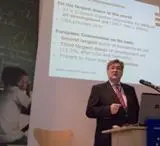
Koos Richelle is Director General of EuropeAid, the European Commission’s (EC) body, which, along with member states and the European Development Bank, represents the largest development aid programme in the world. He says there is a long way to go to be more efficient. But at least everyone is talking and trying to collaborate, whereas in the past, he adds, development cooperation was used for geopolitics, a tool in the Cold War.
“Since 2000 we know what to do and there is worldwide consensus…but there is still a big difference between the policies and practice. We still don’t do what we preach – on both sides,” he said, adding that the push now is to make sure that aid money produced good results by and for the people where it is spent.
There is a shift away from the EC model of funding smaller projects directly, to money through national and regional bodies for local disbursement. Mr Richelle backs this and has come in for criticism from NGOs and tough questioning from WF and other press whose group visit was organised by the European Journalism Centre. But he argued his case by saying that if 800 projects were put up and then 150 were shortlisted and only 40 made it through, and then all the money was finished, this caused a “lot of frustration”. One aim in Brussels is that local stakeholders should monitor their own governments on EU money disbursements on the ground.
In fact regional disbursement may help isolated members in the fisheries sector who just could not cope with the difficulties of making direct EU grant applications. They may be able to group, and tackle their own officials to make sure EU money gets through, and not trapped in national treasuries and ministries.
In one sense, the pot is big. Mr Richelle said the total aid of the 27 countries of the EU equals 60 per cent of global aid. He tempers this by saying each country has the right to operate its own aid policy. “We should be complementary…and as the EU we could be much more forceful if we would unite more than we do now”.
He criticised member states for trying to micro-control the EC’s aid work. The Commission’s ‘own’, separate, aid budget, he says, is bigger than the soft grant wing of the World Bank and makes the EC the second largest donor of humanitarian aid (such as emergency food and disaster assistance for drought, or earthquake or typhoons). Yet, he says, the EU countries fail to look at how effective they are when it comes to operating their own aid policies.
Mr Richelle’s career path seems to make him a natural and passionate ally of the one-boat, local, often poor fishing family. Trained as a lawyer, his first major job was in charge of Dutch adult education and vocational education and training for long-life skills renewal and tackling unemployment. He spent a decade responsible for care of youth and the elderly, disabled, minorities, civil victims of war, pensions, sports, general social policies and “social action”, as well as reception of asylum seekers. Before heading EuropeAid he was the EC’s DG for Development.
Climate cost?
Brussels’ direct assistance for Africa, Caribbean and Pacific etc. countries is some €9.1 billion. Climate is linked so evidently to food production there should be funding overlaps. The fishing industry could ask for funding to reduce emission pollution (and fuel costs!) as well as help to increase low-cost (perhaps discard fish) availability for diet protein, say amongst children. Putting stock straight into consumption, rather than energy intensive fishmeal production for farming, might also attract support.
The big cost question is how much money is needed to mitigate and adapt to climate change if the worst scenarios which some predict come about – more storms, drought and rising water levels?
The answer is a mess. Figures differ as wildly as data on stock levels between scientists and fishermen. Some put the ‘prevention’ cost in the hundreds of billions a year, and two or three times that if no action is taken now. Dr Bruce Denness, familiar to some of our long-time readers, suggests there is some breathing space as he predicts in some regions the warming will stabilise for a decade between 2014 and 2028. But then, he says, with no action, it will spiral up.
Some of Mr Richelle’s colleagues say aid can be wisely and very effectively used to mitigate change, for example in low-lying areas, by looking at the past’s tried and tested tactics for development. One official was head of EC operations in the Pacific Islands’ Forum which includes Kiribati, Tuvalu and Vanuatu. He focused on sustainable energy to operate infrastructure services. Roof-mounted solar power reduces dependence on expensive imported fuel. It can power cold storage buildings which can also be raised above the ground to reduce flooding risk.
Low-lying fishing communities could develop new ideas based on concrete pillared storm shelters. Dried bacalau is sold around the world, yet Senegal’s fishermen only sell their sun-dried fish delicacies locally and fail to tap a world market and avoid cold storage investment.
This is a time to look at old and new solutions. Rising water could bring back into use once navigable rivers to land fish inland and perhaps move farmed live fish by water tank barge for en route sales. Kerala already has deep, manmade shoreline canal cuts to the sandstone cliffs, offering safer launching and landing in difficult seasonal rollers.
Higher water could help coastal land aquaculture in China, India, Bangladesh, Vietnam etc. The flushing of brackish-water, infection-prone ponds could be easier and their expansion inland would need less excavation and so costs. Boat-living communities in Asia may have largely disappeared. But if returning empty oil tankers can carry liquefied CO2 from power stations, decommissioned boats could make a return as ‘working-living’ platforms. The EC may be open to ideas such as moored, old trawlers with onboard processing facilities, or factory ships to move jobs out of land factories at risk of flooding. Rigorous sea-going certification would not be required, power could come partly from sun and wind. Offering moored cold storage, they could tranship to export vessels and avoid the need to raise quays.
So think solutions for worst scenarios and develop fisheries-linked renewables to reduce CO2 emissions. The right ideas could attract climate change money and boost seafood sales.