



European fishermen have stressed the importance of adopting workable and realistic measures which they say has not occurred with the landing obligation.
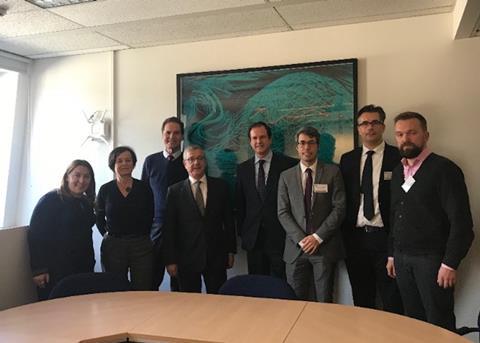
A comprehensive plan was called for as Aguiar Machado, director general of the Directorate-General for Fisheries in the European Commission (DG MARE), met with a delegation of fishing representatives from Europêche to discuss the industry’s concerns relating to recent political and legislative developments at European and international level.
Javier Garat, president of Europêche, declared: “We are at a crucial moment in time, where the decisions taken by the Commission will shape and influence the future of fisheries.
“2019 will be a landmark year defined by the full entry into force of the landing obligation, Brexit, and MSY levels for all commercial stocks. Therefore, we request the full support from the European Institutions to adapt to the new fisheries scenarios and to continue operating both in European and international waters.”
Harsh rules
The enlargement of certain mesh sizes for the demersal fishing fleets, coupled with more environmental standards, stringent objectives, and unchanged catch composition rules will condemn the sector to extinction, said Europêche.
The industry needs maximum flexibility in order to comply with the landing obligation and achieving MSY levels by 2020. Under a full documentation regime, fishermen should be allowed for more flexibility, it added.
Europêche requested further efforts and diplomatic pressure for more fisheries agreements with third countries which must be linked to trade and regional policies.
Sustainability
Mr Machado and Europêche members agreed that Sustainable Fisheries Partnership Agreements (SFPAs) are the most transparent and mutually beneficial global fisheries agreements.
The sector requested diplomatic support at the highest level to renew the agreements with Gabon, Guinea-Bissau, Equatorial Guinea and Morocco on fair terms, among others. It also stressed the need to establish a coherent network of SFPAs to secure fishing access.
Europêche expressed frustration over the latest Regional Fisheries Management Organisation (RFMO) negotiations that took place in the Atlantic and Mediterranean (ICCAT) as well as in the Indian Ocean Tuna Commission (IOTC).
It said the outcome of ICCAT negotiations was disappointing since the sector expected greater quotas for bluefin tuna and the adoption of a management plan following scientific assessment reporting the full recovery of the species.
Allocation manipulation
It added that a coalition of third countries are trying to manipulate the allocation criteria to expropriate the rights of the EU long-distance fleet which has been investing and contributing to the economic development of coastal communities in the Western Indian Ocean. This could lead to a situation where fishing resources allocated to coastal states that are not able to exploit them end up in the hands of the highest bidder, with no adherence to sustainability.
Europêche stressed the importance of relations between the EU and Norway and requested further efforts from the European Commission (EC) to defend the rights of Member States in Svalbard. The situation remains unbalanced and overly favourable to Norway, particularly to the detriment of the EU crabbing fleet, said the organisation.
Other issues discussed included simplifying the framework for the control of fishing activities; trilogue negotiations to adopt the new regulation for the conservation of fishery resources; concerns about the proposal to ban pulse fishing; and Multi-Annual Plans (MAPs).