


Artificial reefs can save the world’s oceans
Activities by petroleum companies such as drilling for oil have also been a factor.
Now, reports Andrew Martin, a Norwegian company is carrying out trials with an artificial reef concept called SeaCult, which shows great promise in attracting fish and other marine life back to parts of the country’s coast where the seabed has been virtually destroyed.
“The large areas off the coast covered by seaweed and other marine vegetation are like the rain forest; if this vegetation dies, so do fish and marine mammals,’ says Sverre Meisingset, CEO of Reef Systems AS of Tønsberg, Norway, who developed the SeaCult artificial reef system. “The bottom of the sea becomes a desert.”
“I have studied the seabed along the whole of the Norwegian coastline for years, and it is depressing to see how sea urchins have eaten everything and left behind a bare bottom,” says oceanographer and biologist Hartvig Christie from the Norwegian Institute for Water Research (NIVA).
According to NIVA, approximately 2000km2 of seabed along the Norwegian coast has already been turned into a marine desert. Mr Christie expects, however, that artificial reefs can regenerate the vegetation.
“Yes, I believe it is possible,” he says. “And so do others. In Japan, for example, they have been spending about $150 million a year on artificial reefs, and we are seeing positive results.”
“Much of the marine vegetation along Finnmark [in the very north of Norway] has already gone. Studies show that as much as 90% [of the vegetation] has disappeared. Sea urchins and the king, or Kamchatka, crab, which was transferred there in the 1970s from the Pacific Ocean, are both to blame. But so is human activity at sea and on land.”
The introduction of Kamchatka crab from the Pacific to the Atlantic coast by Russia about 30 years ago has been disastrous as far as the natural habitat is concerned. This crab, which the Norwegians now call king crab, has thrived in the Barents Sea. It is moving down the coast of Norway from Finnmark, destroying the vegetation as it goes, and has already been observed as far south as Lofoten.
Reef Systems has spent years developing the new reef concept, which has now been tested in various environments. “The idea is simple: just place some artificial reefs on the seabed and let nature take its course. After just a few months, vegetation will appear on the reefs,” Mr Meisingset says.
However, the clue is to maximise the surface or growth area, i.e. the surface of the reef, in as little volume as possible. “You need surface area so that the algae and seaweed can settle on it and grow. The greater the surface area, the more vegetation you will get. By using pipes, you get a maximum surface area (M2) in a minimum volume area (M3).”
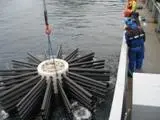
The reefs, manufactured from concrete, are cylindrical in shape with lengths of plastic pipe radiating out from the core like the spokes of a wheel. The centre of the core is filled with rocks to provide ballast and keep the reef in position.
In 2004, a couple of the SeaCult artificial reef units were placed in a ‘dead’ fjord near Risør in southern Norway. During the course of the next two years the results have been astonishing, even to Mr Meisingset. A report on this project, undertaken by NIVA, showed that both the number of fish and marine animals, as well as the diversity of species, had increased dramatically in the area around the artificial reefs.
A similar, but larger, pilot project was started in 2006 in the far north of Norway, near Hammerfest. In a joint exercise carried out with SINTEF (the research foundation founded by the University of Trondheim), the University of Tromsø and Finnmark College, Reef Systems placed 24 artificial reef units on the bottom of a fjord that had been devastated by sea urchins and king crab.
The project was financed by a grant from oil company Statoil and with funds from the Municipality of Hammerfest.
Each of the SeaCult units measured two metres in height and was five metres wide, so that the 24 units together covered an area equal to a football field. The objective was to regenerate the vegetation as well as the biodiversity in the area.
“This field covers a larger area [than that covered in previous projects], and the actual growth area on the reef amounts to no less that 8000 square metres with 8000 metres of hollow ‘rooms’ where fish and marine animals can hide,” says Mr Meisingset.
However, it is not only in Norway that the SeaCult concept is being tested. Pilot projects are being started in Europe and in the Middle East.
In Dubai in the Arabian Gulf, two very large development projects – The Palm and The World – are under construction. These are being built on reclaimed land, and one of the problems that had to be solved was the risk of erosion of the foundations by the sea.
By placing artificial reef units around these installations, the new land is being protected against beach erosion. In addition, marine vegetation has started growing, attracting fish and other aquatic animals.
“We also hope that these reefs can create fishing grounds for traditional fishermen who utilise very simple and traditional, fishing gear,” Mr Meisingset says. “That is exciting.”
Recently the idea of creating a Marine Vegetation Fund along the lines of the Rain Forest Fund, which is claiming to save the rain forest particularly in Brazil, was launched in Norway. Creating these artificial reefs is a long-term activity and it is difficult to link investment in such reefs to a specific economic activity. Therefore, public financing of these projects seems to be the solution, and the Rain Forest Fund model shows some promise; last year it managed to attract no less than NOK6 billion ($945 million) in funds from the Norwegian government.
“We have to think big in this,” says Mr Meisingset. “The ocean is so big, and the ocean means a lot to coastal nations like Norway. The ocean has given us food and a number of activities, and it is time we started cultivating it, giving something back to the ocean.”