


Plastic – enemy of the sea
The British Plastics Federation (BPF) attempts to whitewash this admission by claiming, “Plastic materials are generally inert and lend themselves to product safety-critical situations such as food and pharmaceutical packaging, toys and medical implants”.
The federation also simplifies the constant introduction of new plastic pollutants by claiming to be just borrowing the oil it uses, and that it can easily be reclaimed by re-cycling or burned as fuel, but any such reassurance cannot be justified when plastics are allowed into the marine environment.
Plastics are far from inert and when they enter water courses – they are proving to be extremely dangerous. Even the humble supermarket carrier bag, which every person in the UK uses at least 150 of annually, is now being blamed for transmitting false oestrogen to male fish, causing sterility. Newly hatched trout in an Australian river are being born with two heads, allegedly as a result of the chemical used to spray Macadamia nut trees in Queensland.
Apart from the small amount of material which is burned in an incinerator, almost every item of plastic ever made still exists. Whether buried in land-fill, floating at the centre of our oceans, lying on the sea bed, or on beaches and rocky shores, scientists believe the most dangerous place for plastics to exist is in the sea.
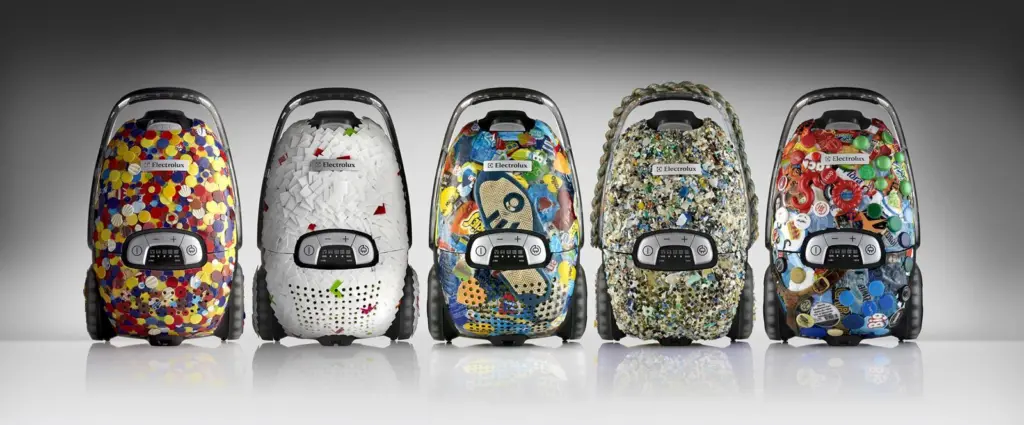
Recycled vacuums
To assist in improving global awareness of the environmental damage being caused to sea organisms as small as zooplankton up to the orca and blue whale, Electrolux, is using five brightly coloured upright vacuum cleaners, their case components moulded entirely from fragments of abandoned plastic. Collected from beaches and coral reefs fringing the five continuously rotating ocean currents, North/South Atlantic, North/South Pacific and the Indian Ocean, are named collectively as The 5 Gyres.
Electrolux sells 40 million products to 115 countries annually and achieves 55% recycled content within its black coloured plastic mouldings, claiming 99% of the components recyclable at end of life. Electrolux also recently sponsored a crew member to join one of the 5 Gyres organisation voyages to carry out plastics pollution research.
5 Gyres is increasing understanding of the environmental impact of plastics pollution by sailing through the subtropical gyres. Together with its partners, Pangaea Explorations and the Algalita Marine Research Foundation, it has been piecing-together the most accurate picture of pelagic plastics pollution ever created, by trawling the surfaces of the Atlantic and the North Pacific, the largest eco system on the planet. At its centre, is a garbage patch as large as Texas, with concentrations of plastics pollution said to weigh over 100 million tons and in greater density than the natural zooplankton, which make up the diet of most juvenile fish.
When a carrier bag enters a river and reaches the sea, turtles, whose natural life span can last well over a century, regularly mistake the floating nuisance for jelly fish, their main sources of food, which invariably ends in death by starvation.
Post mortems carried out on fish and marine mammals almost always reveal large quantities of solid plastics inside their stomachs. Stranded dolphins porpoises and whales are also found to have swallowed discarded plastic bags, coffee cups, pellets and sections of fishing nets, and it is believed every whale species is now on the brink of survival, notwithstanding all the other manmade pressures placed upon them, due to the accumulation of chemicals such as Polychlorinated Biphenyls (PCB’s), and persistent organic pollutants (POP’s) such as Zylene, Toluene, Sulphur, Melamine and Formaldehyde retained in their blubber and vital organs. Female whales, dolphins and orcas then pass the absorbed chemicals to their babies via their milk.
As technology increases, every new man-made compound or chemical finds its way into the sea. As plastic never completely degrades, constant wave action and incessant pounding against rocky shorelines, plastic bags, bottles and containers are gradually reduced to tiny fragments which end up as particles less than 12mm in diameter and become part of the floating garbage patch at the centre of one of the gyres. Invisible to satellites, the only accurate way to determine how much plastic is suspended in our seas, is by towing fine mesh trawl nets through the water.
Nylon was invented in 1936, and by1939 monofilament fishing line was being used to catch fish all around the world. Line lost by fishermen at the beginning of the last war, seven decades later, is still causing problems for aquatic life.
Waste documented
The 5 Gyres team of researchers collect trawled samples every 60 miles, documenting waste such as nylon fishing nets, drinks bottles, carrier bags, cartons, plastic chips and granules as well as cosmetic and pharmaceutical containers, to name just a few.
According to particle size and colour, plastic fragments are readily mistaken for food. Unwary victims range from fully grown adults, juveniles and the recently hatched offspring of mammals, amphibians, fish and birds, creating the possibility for a complete species to go extinct from a single pollution source.
An excellent example of such a ‘circle of self-destruction’ is the albatross. It scoops-up plastic debris, believing it to be an abundant source of food and repeatedly flies back and forth over hundreds of miles to feed its single chick. Energy expended by the adult is completely wasted as its chick will inevitably die. As the carcass decomposes, the plastics are re-exposed to the elements and it is only a matter of time before they are wind-blown or washed back into the sea to kill again.
Sea creatures cannot break down solid plastic foreign bodies, so they gradually absorb high concentrations of toxic chemicals into their body tissue. When we eventually eat these fish, we do not know what long-term effect this will have on human health. And is it right to consume the chemical which makes shampoo bottles smell of fresh apples with our fish suppers?
Every fisherman and land lubber alike, must now be committed to cease pumping, throwing, dumping and towing what he no longer needs into our seas. And the day may not be very far away when fishing quotas are decided merely by the type and percentage of chemical pollutants retained within the bodies of the fish they wish to catch.