



“Not all that can be measured is important and not all that is important can be measured” - Albert Einstein - I have on my desk a copy of “Management of tuna fishing capacity: conservation and socio-economics” (FAO Fisheries Proceedings 2 – publication-sales@fao.org. 2005, 336 p). The book presents results of studies carried out under a Japan-funded project of the same name. It deals with (i) development of tuna fisheries since their inception, including trends in tuna fishing technology and tuna catches; (ii) the status of tuna stocks; (iii) tuna catch data; (iv) purse-seine and longline fishing capacity; (v) non-industrial tuna fisheries; (vi) the tuna market influence on catches; and (vii) management of purse-seine and longline tuna fishing capacities, past and future. This book, edited and partly written by three experts on tuna resources - W.H.Bayliff of Inter-American Tropical Tuna Commission, and J.I. de Leiva Moreno and J.Majkowski, both of FAO Fisheries - comprises contributions from several others including two outstanding specialists, P.M. Miyake and James Joseph.
The way the editors handle the section “Status of the tuna stocks in the world” (p.58-114), drew my particular attention. They don’t produce stock figures nor tell the world how many fish of the various tuna species swim in the ocean (some call it, for some reason “standing stock”), and, with only one or two exceptions, don’t say how many fish can be safely captured. What they tell the reader is how various fisheries should behave in the future.
Their recommendations are based on assessments how far the size of a given species’ population is from certain optimum reference points. These points are estimated on the basis of past catches, various models, and estimates by regional tuna commissions. Stocks are described as being “above”, “above-near”, “near”, “near-below”, “below”, or “unknown”. Accordingly, fisheries are advised to “reduce” their catches, “not to increase”, “increase, but to an unknown extent”, or “increase, but only after the 0 and 1-class mortality could be reduced”.
Outlook
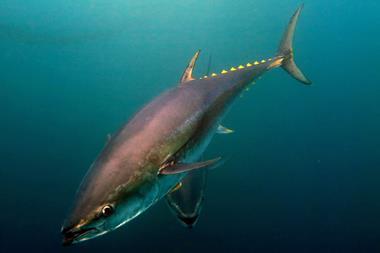
Thus, for example, Indian Ocean, East and West-Central Pacific skipjack, and South Pacific albacore are the only stocks with potential for some increases in their catches. All stocks of bigeye, yellowfin, Atlantic and Pacific bluefin tunas could possibly also produce increased yield, but only if catches of their younger, smaller individuals could be reduced. Fishing for all others should be reduced.
Their assessments and other chapters make “Management of tuna fishing capacity” an exceptionally important book that’s authoritatively summing up the present knowledge of tuna resources and their fisheries, and most useful to all who are involved in the capture operations, management and research, or otherwise interested, in any local, regional, or global tuna fishing industry.
The manner in which de Leiva and Majkowski present their assessment of tuna stocks reminded me of the fuzzy logic approach to some realities of our world. The fact is that, apart from exact sciences and technologies, most of our science, from medicine to ocean ecology and climatology, deals with dynamic, unstable, and not fully known systems. As a rule, we’re trying to handle such scientific matters using various statistical methods. In some cases, however, statistical-mathematical models are plainly inadequate to handle complex situations, especially where the data they’re fed with are insufficient, unreliable, or otherwise lacking. One example is fisheries science and management.
Fuzzy logic
Some 40 years ago, Dr. Lotfi Zadeh, of the University of California at Berkeley, introduced the concept of fuzzy logic to model the uncertainty of natural language. It is a tool, which handles realities that cannot be truly expressed in absolute figures. This concept assumes that the known values represent partial truths, somewhere between "completely true" and "completely false". Formally it is a branch of mathematics that allows a computer to model the real world by imitating human reasoning, and provides a simple way to reason with vague, ambiguous, imprecise and noisy input or knowledge. Most important, it provides a flexible approach to solving problems.
Introducing fuzzy logic to fisheries science should help fisheries scientists and managers to stop representing their discipline as an exact or a quasi-exact science, and the presently dominant fish population dynamics models, as a reliable tool for objective assessment and forecasts. Quantification and "mathematisation" of fishery science is not the only way to describe and explain the ecosystem in which people encounter fish and the environment. A growing number of fishery scientists think that unquantifiable information, ignored in the present models, must be taken into account. Any calculated or assessed fish stock values and catch quotas should be accompanied, or where necessary, replaced by relevant verbal or “fuzzy” descriptions, reservations, additions, corrections, etc.
The following is a layman’s example how fuzzy logic can represent a given stock assessment:
The biomass of a stock is estimated at between 100,000 and 200,000 tonnes
There's little chance, say 10%, that it is between 100,000 and 120,000 and between 180,000 and 200,000 tonnes
There's more chance, say, 20%, that it is between 120,000 and 130,000 and between 170,000 and 180,000 tonnes
There's more chance (about 30%) that it is between 130,000 and 140,000, and between 160,000 and 170,000 tonnes
And, finally, the best chance, say 40%, is that the biomass is between 140,000 and 160,000 tonnes.
The above is a simplified example, but in many cases such an approach would be both reasonable and reliable, and its integration with fishermen’s information and catch and environment time series, should enable sensible selection of management steps. To my fisherman’s mind it makes more sense than an assessment stating that, for example, the stock size is 143,500 tonnes, and the TAC should be 67,530 tonnes. With such virtual counting of fish in the sea, one wouldn't know whether to laugh or cry…
Which is why I’m looking for a partner to write a guide on the application of some sort of fuzzy logic to fisheries management.