

Dashboard upgrade showcases ASC’s growing impact
The Aquaculture Stewardship Council (ASC) has launched a new Impact Dashboard, showcasing updated features such as comparison tools, interactive maps and charts.
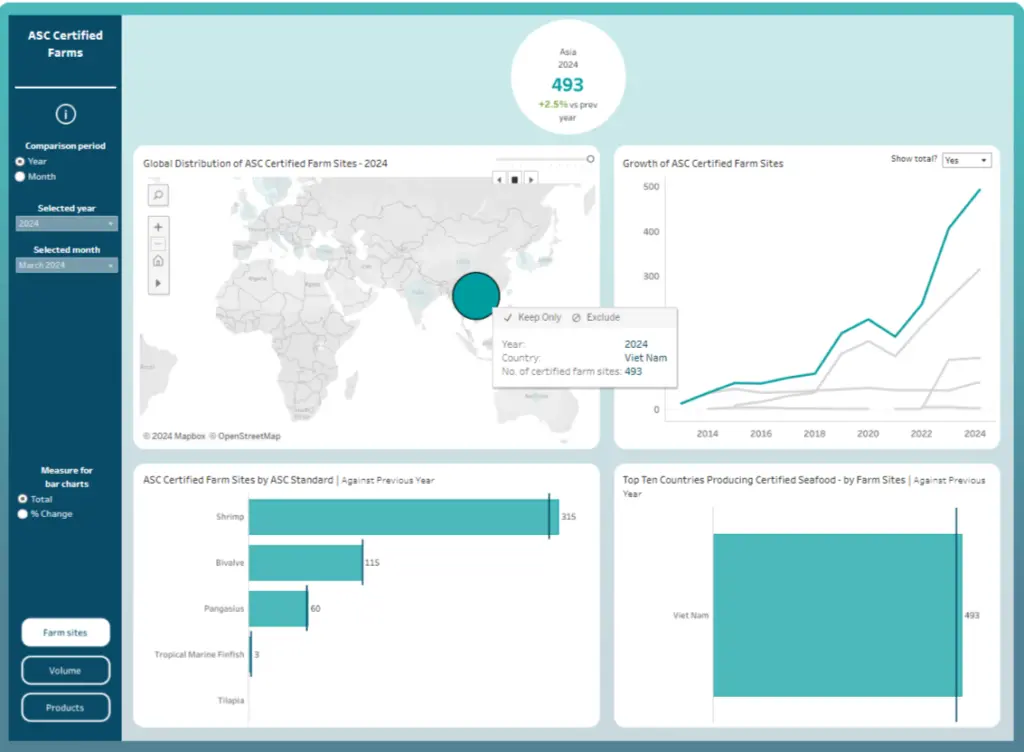
“The redesigned dashboard uses the latest data visualisation techniques to make it easier for users to view and collect information on ASC’s impact. Visualising data and allowing users to filter to geographies and years of interest and export chart images can help businesses, producers, and retailers make informed business decisions,” ASC Director of Impacts, Monitoring & Evaluation Jill Swasey said.
“Using this powerful tool, stakeholders can easily compare ASC certified production volumes, farm sites and labelled products year-on-year and view trends. With just a simple click on the map, users can also explore the number of ASC certified farms in a country, the species being farmed on site and its growth compared to previous months or years. For example, zooming in on Vietnam, users can see that the number of ASC certified farms has been steadily growing since 2021, with shrimp as the main species produced.”
The dashboard’s redesign was completed in partnership with TIL+ The Information Lab who provided services pro bono to ASC.
“Our focus is to support NGOs that often lack the time and resources to scale up and develop their analytics capabilities. As a pro bono programme sponsored by The Information Lab, a tech consultancy company with high in-house tech skills, we utilise our consultants’ downtime between clients to practice and contribute to social progress. We reviewed ASC’s mission and felt that the organisation aligns with the type of NGOs we wish to support,” The Information Lab’s Culture & Inclusion Lead Benedetta Tagliaferri said.
Dorinna Pentchev, Data Consultant at The Information Lab, said: “We believe the end result provides an easy way for viewers to see how ASC’s global footprint has been growing over time, with the ability to focus on specific species and locations. This was made possible through a variety of visualisations, filters, and click actions.”
Related Articles
 SEAFOOD
 AQUACULTURE
 AQUACULTURE