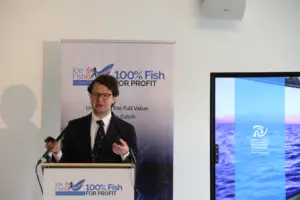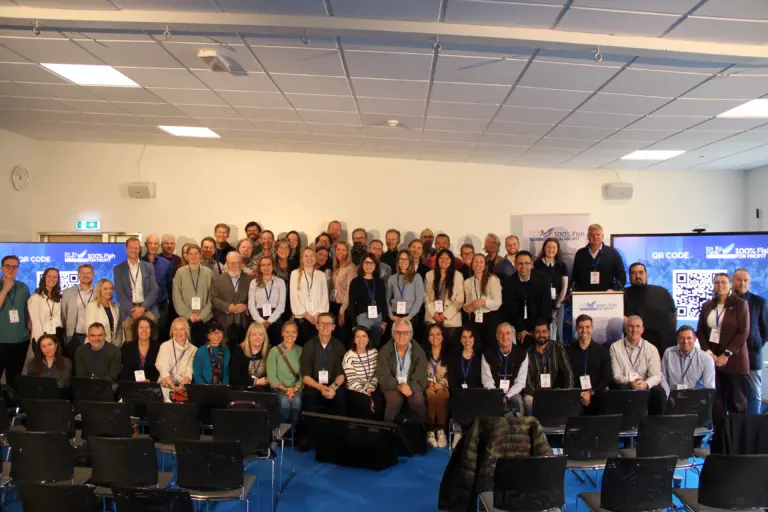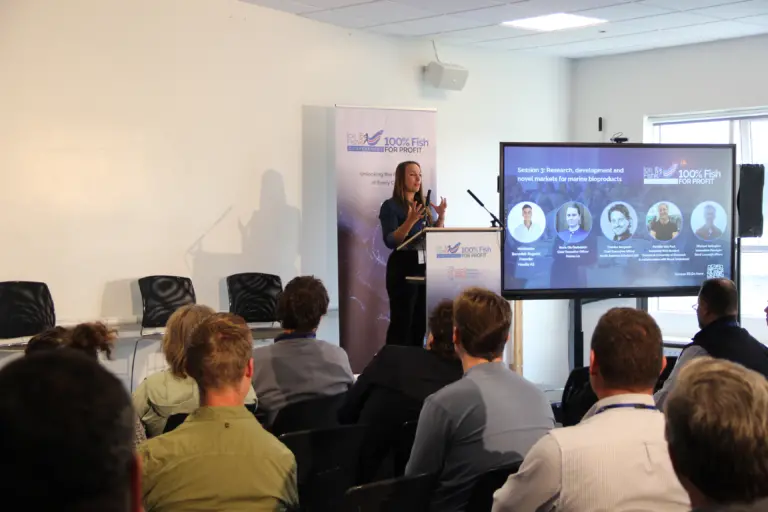
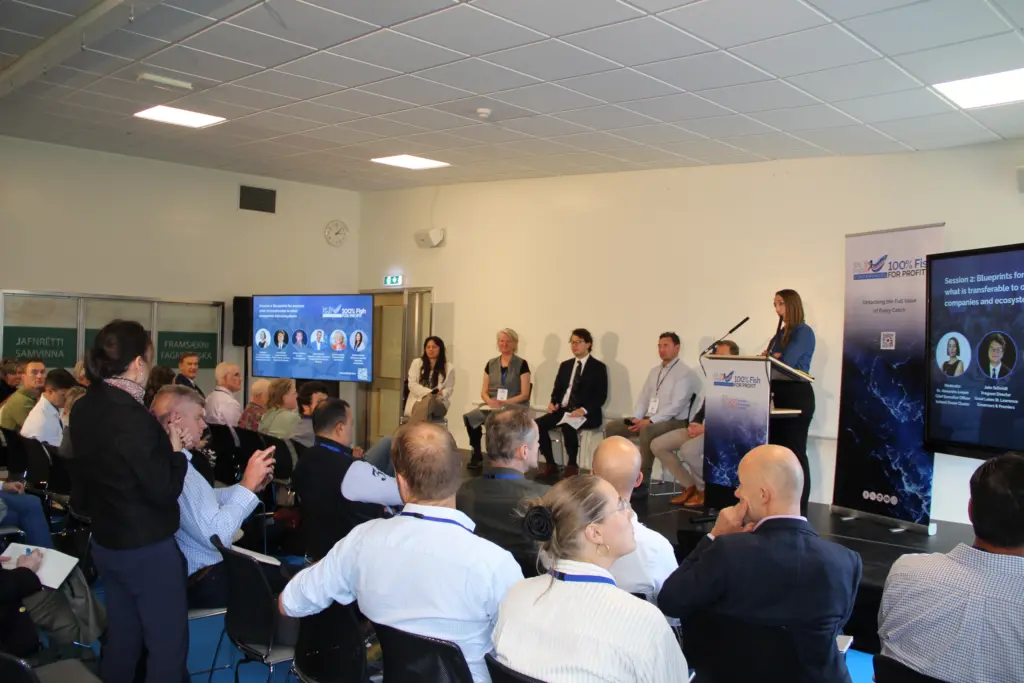
John Schmidt serves as Program Director for the Great Lakes St. Lawrence Governors & Premiers and leads the 100% Great Lakes Fish Initiative, a regional collaboration across the Great Lakes St. Lawrence Region which is demonstrating how cooperation between fishing businesses, researchers and markets can dramatically reduce fish waste while creating new value.
John explained that the 100% Great Lakes Fish initiative was established to address a sector where around 60% of each processed fish was traditionally landfilled or put to low value uses, generating about 14 million kg of material annually.
He revealed their first performance report with some great figures – more than 90% of the commercial catch is being productively used, while 8,200 metric tonnes of material have been diverted from landfill, resulting in more than 4,500 metric tonnes of avoided CO₂ emissions.
50 organisations have now signed its 100% Fish Pledge. John commented, “Our pledge… naturally built a network of all sizes to connect, which are also located close to local clusters”
The programme has attracted more than US$700,000 in grant funding and received two major awards, providing further recognition of its approach to improving the economic and environmental performance of the Great Lakes fishing industry.
John was followed by Kristian S. Ottesen, Director, Royal Greenland. His presentation, “From side streams to strategic value” started with examining ” The Seafood Industry Paradox ” – the fact that the industry “harvest(s) finite resources…But often monetize(s) only part of them”
Kristian said, “The seafood industry is facing increasing pressure from many corners. Systematically transforming side streams into profitable products is our ambition. At Royal Greenland we changed our perspective…side streams are not waste; they are raw materials, products, markets, business opportunities.”
Kristian explained that, rather than measuring production efficiency alone, the company is shifting its focus towards the value generated per tonne landed. Its model maps available raw materials, assesses market opportunities, prioritises projects according to value, volume and feasibility, before piloting and scaling successful products.
Side-stream volumes reached 4,524 tonnes in 2026 year-to-date, already exceeding 2025’s 4,338 tonnes, with around 5,655 tonnes projected for the full year. The company also introduced 17 new side-stream products in 2026, including products from cod and prawns.
Kristian concluded “By 2030, Royal Greenland aims to become the preferred partner for full resource utilisation in the North Atlantic, arguing that seafood’s future lies in creating more value from existing resources.”
Presentation three in the second session of the 100% Fish for Profit conference was from Geert Hoekstra, Economic Researcher Seafood, Wageningen University & Research. He outlined how collaboration could help the Netherlands maximise the value of seafood side streams and move towards 100% fish utilisation. Using a phrase from Dutch Formula One, Geert said, “Winning or losing comes down to the smallest details.”
He pointed out that the Netherlands is a major northern European seafood hub, creating substantial opportunities to convert processing byproducts into higher-value products. Estimated annual byproduct potential includes 57 million kg from salmon, 39 million kg from blue mussels, 14 million kg from plaice and 2.7 million kg from oysters.
The “Nose of the Salmon” project is developing eight pilots, spanning salmon leather, pet food, broths, food supplements, plaice products, soil conditioners and automation. While much seafood material currently goes to fishmeal production, researchers there see opportunities for greater value creation. The phrase is a Dutch idiom meaning ” the very best thing you could image / most delicious part! “
Geert argued that success requires an entrepreneurial ecosystem built around trust, shared knowledge and collaboration, bringing together businesses, researchers, skills, technology and resources to accelerate innovation and achieve fuller seafood utilisation.
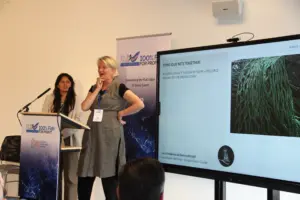
The final presentation in session 2 was from Laura Anderson, Founder & CEO of Local Ocean and Darlene Khalafi, Business Innovation Specialist at Local Ocean.
Under the great heading, ” Tying our nets together” they demonstrated how collaboration and resource-sharing can help smaller seafood businesses turn underused fish material into new products and revenue streams on the Oregon coast.
Based in Newport, Oregon, the company initially explored creating a dedicated business to commercialise seafood side streams but found that strengthening existing networks offered a more effective starting point.
Laura and Darlene pointed out that shared processing facilities, labour, expertise and partnerships have enabled new products to reach the market while reducing investment risks, “Within a year the town was talking about Local Oceans sustainable mission and our products were sold out of every local boutique and tourist store. Word of mouth travels in our community because we gave our locals something to be proud of…”
They introduced an early success to the delegates, fish-skin dog treats, which used all of Local Ocean Seafoods’ own available byproduct within a year. The approach is now being replicated for products including broths, snacks and ready-to-eat foods.
Delegates heard that the wider Oregon Ocean Cluster now involves more than 100 partners, including businesses, schools, researchers and retailers. Its ambition is to extend the model across Pacific Northwest fishing ports, creating stronger coastal economies through 100% fish utilisation.
Laura and Darlene concluded with their learned lessons, “Lesson 1: Cultivating human capacity is more important than advancing technology, Lesson 2: Build the network before you build the infrastructure, Lesson 3: Collaboration prevents leakage.”
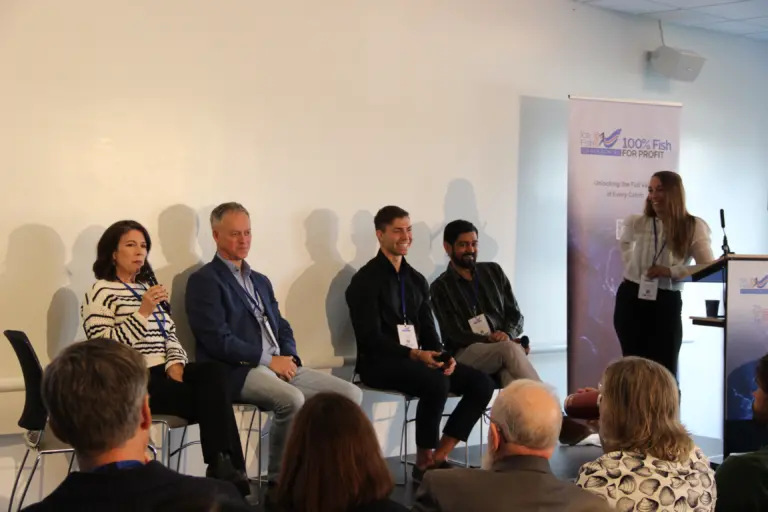
The final presentation was followed once again with the speakers taking questions, moderated by Dr Leeping of the Iceland Ocean Cluster.